
Safest Car Setup For Your Dog: Combining Seat Covers, Harnesses, Tethers, And Barriers
Many owners buy one item and assume they are finished. In reality, the safest car setup for dogs comes from how the pieces work together. A stable surface helps your dog maintain its balance. A harness gives the tether a safe load path. A tether limits forward travel during sudden stops. A barrier can also add separation in cargo-area setups.
If you want the big-picture foundation first, start with how to travel in a car safely with your dog. Then use this guide to build a complete, repeatable system.
The Four Components Of A Safe Dog Car Safety Setup
A reliable dog travel safety system solves four different problems. Each component has a job.
| What Each Component Does |
|
Why Seat Covers Are The Foundation Of Safety
Dogs react to motion before the tether ever goes tight. If the surface is slick or collapses, your dog is already sliding forward or bracing into doors during braking and turns. That extra movement increases stress, makes your dog feel unstable, and can reduce how controlled the restraint feels.
That is why why is a hard bottom dog seat cover important comes down to stability and predictability. A hard-bottom base supports footing, reduces sag, and helps dogs settle faster instead of constantly correcting their balance.
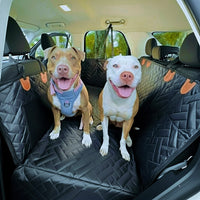
If you are building a system from the seat up, a hard-bottom dog seat cover for stable car travel is the simplest way to create a consistent foundation for the rest of your setup.
Harnesses: Restraining The Dog, Not The Neck
A dog harness and seat belt setup should always start with a harness, not a collar. Collars concentrate load on the neck and can create dangerous pressure when a dog reaches the end of the tether. Harnesses are designed to distribute force across the chest and torso.
- Rear-clip alignment matters: a centered back attachment point typically pairs best with tethers.
- Chest support matters: wider, more supportive designs usually spread load better than thin straps.
- Fit matters more than brand: too loose increases travel distance; too tight can restrict breathing.
When your harness compatibility article is live, use it here to support readers who are deciding between harness styles and brands.
Seat Belts And Tethers: Limiting Forward Motion
A tether does not freeze a dog in place. It reduces how far they can move forward in a sudden stop. The goal is controlled movement that keeps your dog more centered and prevents them from lunging into the front cabin.
In practice, setup details are what make a tether usable every day. If you frequently buckle in and out, you want seatbelt access to stay easy around your cover so the restraint does not become a hassle you skip on short drives.
For the tether itself, use a dog seat belt harness fit guide mindset: keep slack minimal while still allowing your dog to sit and lie down comfortably.
Barriers: Dog Car Barrier Vs Harness
A barrier is not the same thing as a restraint. A barrier helps manage space by reducing the dog’s ability to move forward into the front cabin, especially in cargo-area travel. But it does not attach to your dog, and it does not control forward travel the way a harness and tether do.
Barriers make the most sense when you are using the cargo area in an SUV or wagon, or when you have multiple dogs and need separation. If that is your layout, dog seat covers for suvs cargo and backseat guide helps you think through zones, surfaces, and coverage.
- Best use case: cargo-area travel where separation reduces distraction.
- Important reminder: barriers work best when combined with proper restraints.
Putting It All Together: Safe Setup Examples
Use these scenarios as templates. The best safest way for dogs to ride in a car is the one that matches your dog’s size, mobility, and how you actually drive.
One Large Dog In A Backseat
- Stable hard-bottom seat cover
- Rear-clip harness with supportive chest fit
- Short-to-moderate tether length with minimal slack
Two Dogs In A Truck
If you routinely travel with two big dogs, follow the layout guidance in dog seat cover for two big dogs setups and focus on two separate restraints rather than one shared tether concept.
- Full-width stable cover so the surface stays predictable across the bench
- Individual harnesses
- Individual tethers with controlled slack
Senior Dog Or Mobility-Limited Dog
For arthritis, hip dysplasia, or general stiffness, stability is not a nice-to-have. It is the difference between bracing and settling. Use dog car setup for arthritis or hip dysplasia as your template and keep the system simple and repeatable.
- Flat, stable base
- Minimal slack while still allowing a comfortable lying position
- Shorter rides and predictable breaks
Common Safe Setup Mistakes To Avoid
- Relying on a hammock alone as a “safety device.”
- Clipping a tether to a collar.
- Letting dogs ride on loose blankets that slide on braking.
- Leaving excess slack that increases forward travel distance.
- Ignoring cover movement and drift on smooth seats.
If your cover shifts, everything attached to it becomes harder to use consistently. If you notice drift, start with how to prevent dog seat covers from slipping and tighten the system before you assume the restraint is the issue.
Final Thoughts: Safety Is A System, Not A Single Purchase
The safest setups are predictable. They keep dogs balanced before the tether engages, and they make restraint easy enough to use on every drive. When you combine a stable surface, a well-fit harness, controlled slack, and separation when needed, you get a calm, repeatable routine that protects dogs and passengers during real driving.
If you are building your system from the foundation up, start with a build a stable, restraint-ready dog car setup approach and make stability the first decision, not the last.
To finish the setup, many owners pair their restraint system with the waterproof Whisker Bark dog seat cover so the backseat stays stable, protected, and easier to keep clean on real trips.
Share