

Best Car Setup for Dogs With Arthritis or Hip Dysplasia
For a dog with arthritis or hip dysplasia, the two things that matter in a car are the surface they stand on and how they get in. Everything else is secondary. A flat, stable base stops the constant bracing that leaves a dog stiff on arrival, and a ramp or a lift removes the jump that does the real damage.
The instinct is to reach for padding. Padding is not what helps. A soft surface that shifts under a dog's weight makes them work harder, not less, because every small movement has to be corrected. Support beats softness here, and it is not close.
Who This Is For
Senior dogs who are slow to sit, stand or settle once the car is moving. Dogs diagnosed with hip dysplasia or osteoarthritis, particularly large breeds who cannot brace comfortably through turns. And dogs who still travel fine but have started hesitating at the door, slipping on the seat, or seeming stiff when you arrive.
If your dog cannot bear weight, cries when repositioning, or suddenly refuses to move, stop and call your vet rather than adjusting the car.
Why the Car Is Harder Than It Looks
Osteoarthritis is a progressive joint condition involving pain, inflammation and difficulty using the affected limb, which means small shifts in pressure register more than they used to. Cornell's canine health centre has a good overview of how it progresses.
Hip dysplasia is abnormal development of the hip joint, most common in large breeds but possible in any dog. When hips are already sensitive, sliding legs and awkward angles in a moving vehicle turn an ordinary drive into sustained low level effort.
The thing owners miss is that the problem is rarely the length of the trip. It is that the ride is unstable, and instability costs a joint sensitive dog far more than it costs a young one.
What Actually Goes Wrong
- Seat contour. Bucketed cushions tilt the body, so the dog spends the drive correcting posture.
- Centre sag. Soft covers and hammocks dip toward the middle, pulling hips and legs into positions the dog would not choose.
- Slick surfaces. Leather and smooth fabric let paws slide on every turn and stop.
- Bad tether angle. A tether pulling upward or sideways twists the torso instead of simply limiting forward movement.
- Bunched fabric. Seams and folds create pressure ridges under hips, elbows and shoulders.
Four Checks That Take Two Minutes
Do these with the car parked, then repeat after one short drive. Plenty of setups feel solid in the driveway and fail after the first few turns.
- Slip check. Press down on the cover and push it forward and sideways. If it walks easily under your hand, it will move more under a dog.
- Sag check. Press down in the centre of the seat. If the middle collapses noticeably, expect bracing and repositioning.
- Buckle check. Make sure the seatbelt buckles are easy to reach. A restraint you have to dig for is a restraint you will skip.
- Entry rehearsal. Watch your dog step in without hurrying them. Hesitation, a slip, or an awkward hop tells you to fix the entry before you fix anything else.
Getting In and Out, Which Is the Hard Part
For most arthritic dogs the drive is manageable and the doorway is not. One badly landed jump undoes a good week, and dogs who have had a bad landing start refusing the car entirely.
Ramp or steps?
It depends on the dog rather than the vehicle, and the distinction is worth understanding because most people buy the wrong one.
A ramp keeps all four feet on a continuous surface and never asks the dog to lift their own weight. That makes it the better choice for dogs with hip or hind limb problems, dogs who are weak rather than just stiff, and large dogs where a misstep carries real force. The tradeoffs are that ramps are long, they need a shallow angle to be useful, and a steep ramp is worse than no ramp because dogs will not commit to it.
Steps take up far less space and store more easily, but each step is a small jump, which is exactly the motion you are trying to remove. They suit smaller dogs, dogs who are stiff but still strong, and lower vehicles. They are a poor fit for a dog with hind end weakness.
Whichever you use, introduce it at home on flat ground before you need it. A dog meeting a ramp for the first time in a car park at night will not use it.
If you are lifting
Support the chest and the hindquarters together, keep the dog's spine level, and do not lift under the belly alone. A rear support harness with a handle makes this far easier and is worth having before you think you need it. If your dog is heavy enough that lifting is a strain, that is the answer to the ramp question.
The threshold
Most slips happen on the first paw placement rather than mid climb. Traction where that first paw lands matters more than anything further in.
Build the Base Before You Add Anything Soft
| Problem | What you see | What helps |
|---|---|---|
| Centre sag | Dog sinks inward, shifts often, braces hard through turns | A flatter platform with minimal flex and fewer folds |
| Slippery footing | Paws scramble on braking, dog hesitates to stand or turn | Non slip backing plus a grippy top layer that does not slide |
| Bunched fabric | Dog avoids certain spots or circles looking for a good one | Tighter install, fewer wrinkles, a flat top layer |
If your dog prefers something softer, add cushioning on top of a stable base rather than instead of one. A thin familiar blanket works well as long as it does not slide, and a blanket that slides cancels out everything underneath it.
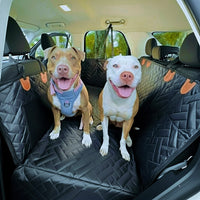
Our hard bottom seat cover is built around a rigid panel for this reason, and it sits flat rather than hanging between the seat edge and the floor.
There is also a step in advantage that gets overlooked. A flat cover has no front wall to clear, where a hammock style cover asks a stiff dog to climb over a raised barrier on the way in. Our guide to why a hard bottom matters covers the difference.
Small Cars Have Their Own Problems
Compact cars are not automatically worse for an older dog, but they compress the margins in four specific ways.
The bench is tighter, so there is less room to reposition, which matters more for a dog who needs to shift often. The footwell drop is proportionally more pronounced, so a sagging surface has further to fall. Door openings are shorter, which forces more twisting on entry, and twisting is the motion arthritic hips tolerate worst. And buckles sit closer together, so belt routing gets awkward and strap angles are less forgiving.
The fix in a small car is the same as anywhere else, just less optional: remove the wobble, flatten the surface, and reduce twisting at the door. If entry is the problem, a shallow ramp at the door often does more than any interior change, because it lets the dog walk in straight rather than turning as they climb.
Restraint That Does Not Twist
A restraint should limit sudden movement without forcing the body into a bad position, and it should never run to a collar. Veterinary guidance is consistent that pets should be restrained rather than loose in a vehicle.
Fit matters more than brand: snug without rubbing the armpits or pinching the shoulders. The dog should be able to sit, lie down and shift without the tether pulling them sideways. After you clip in, watch the angle when they lie down, and shorten or reroute if it drags the torso rather than simply limiting forward travel.
On which harnesses have actually been tested independently, and why most crash tested claims mean nothing, see our guide to securing a dog in a car.
Pacing the Drive
Stiffness builds quietly during a drive and announces itself when the dog tries to stand at the other end. Frequent gentle breaks are worth more than one long stop.
Keep the breaks calm, slow walking rather than a burst of activity. Let the dog rise in their own time before asking for stairs or a long walk. And minimise in and out cycles if impact is the issue, since four short stops means four entries.
What to Watch During the Ride
Any of these means stop and reassess rather than push on: repeated bracing with a wide stance and stiff legs, a refusal to lie down, pacing and constant repositioning, any slipping at all, or new signs of discomfort such as trembling or reluctance to get back in.
A dog who will not settle on a surface has usually decided the surface cannot be trusted, and one or two slips is enough to make that decision.
When to Talk to Your Vet
This is a guide to comfort and stability rather than treatment, but changes around car travel are a useful signal to bring to an appointment. Stiffness that is noticeably worse after arrival. Reluctance to get in even for somewhere they like. Whining, panting or restlessness that reads as discomfort rather than excitement. Difficulty standing after a ride.
Cornell notes that pain in dogs often presents as stiffness, limping, trouble moving, or difficulty getting up, and those are easy to attribute to age when they are worth investigating.
If your dog is also anxious about the car, which frequently develops after a period of finding it uncomfortable, our guide to car anxiety in dogs covers undoing that association.
The Short Version
Fix the entry first, because the jump costs more than the drive. Choose a ramp over steps for a dog with hind end weakness, and introduce either one at home rather than in a car park. Build a flat, stable base and add softness on top of it rather than instead of it. Keep the tether short enough to limit forward movement and loose enough not to twist. Take gentle breaks. And treat a dog who will not lie down as a setup problem rather than a mood.
Share