

Why a Hard Bottom Dog Seat Cover Matters for Big and Senior Dogs
A hard bottom dog seat cover uses a rigid base panel instead of fabric tension, so the riding surface stays flat under your dog's weight. It matters most for dogs over about 60 pounds, senior dogs, and two dogs sharing a bench, where a hammock cover sags into the footwell and dogs slide toward the middle.
Most covers feel fine in the driveway. The problems show up three weeks in. The cover has crept forward, the middle has dropped into the footwell, your dog is sliding on every turn, and you are re-tightening the straps again.
That is not a quality problem with the fabric. It is a structural one. A soft or hammock cover holds your dog up with nothing but strap tension, and tension fails predictably under weight and movement. A hard bottom dog seat cover replaces that tension with a rigid base, so the surface stays flat whether your dog weighs 20 pounds or 90.
What a Hard Bottom Dog Seat Cover Is
A hard bottom dog seat cover is a rear seat cover built around a rigid or semi-rigid base panel. Instead of hanging like a sling between the seat edge and the floor, the panel bridges that gap and creates a level platform.
Structurally, three things separate it from a standard cover:
- A load-bearing base. Weight transfers into the seat cushion itself rather than into headrest straps.
- Consistent height across the bench. The middle is not the lowest point.
- Straps that position rather than support. They hold the cover in place; they do not hold the dog up.
That last distinction is the whole thing. On a hammock, the straps are the floor. On a hard bottom, they are just keeping the floor where you put it. If you are still deciding which style suits your vehicle, our guide to choosing the right dog seat cover walks through the wider set of options.
Why Soft and Hammock Covers Sag
Not because they are badly made. Because of how they carry load. A hammock is a tension structure, and tension structures degrade under four specific conditions. All four describe a real dog in a real car.
Span length. The wider the bench, the more unsupported distance in the middle. An SUV or minivan bench gives fabric far more room to belly out than a sedan does, which is why the same cover behaves differently between two vehicles in the same driveway. Our SUV seat cover guide covers bench geometry in more detail.
Strap creep. Webbing slips at the buckle in increments too small to notice. You tighten it, it feels solid, and a week later it has quietly surrendered half an inch. A structure that depends on tension loses its entire advantage when tension drops.
Anchor angle. If the headrest straps pull downward instead of backward, they are loading the fabric in the same direction as the sag rather than against it. Some vehicles simply do not offer good anchor geometry, and no amount of tightening fixes that.
Fabric stretch. Repeated impact, such as a 70-pound dog launching into the back seat twice a day, permanently elongates the center section. This is the one you cannot undo by re-tightening.
The result is a set of failure modes owners describe constantly without connecting them to a common cause:
- Footwell sag: the center dips into the gap between bench and floor, creating a slide-to-center surface.
- Sling effect: the fabric hangs like a swing, so footing changes during turns and braking.
- Drift: the cover shifts slightly each trip until it bunches at the centerline or pulls off the seat edge.
- Anchor pull-up: seat anchors pop out of the crease during entry and exit, especially when dogs jump in fast.
- Concentrated wear: covers fail in the same two or three spots rather than evenly, because slack becomes wrinkles and wrinkles are where claws catch. This is usually what determines how long a seat cover actually lasts.
What Sag Actually Does to a Dog in Motion
Two and a half inches of dip does not sound like much until you picture it underfoot. Your dog is not standing on a flat surface with a small depression in it. They are standing on two slopes that meet in the middle, with gravity pulling them toward the low point for the entire drive.
On a straight road they can hold position. In a turn they cannot, because lateral force stacks on top of the slope they are already fighting. So the dog braces: wide stance, stiff legs, weight dropped low. That is not a dog riding. That is a dog working.
Two consequences follow, and owners notice both without linking them to the cover.
The dog will not lie down. This gets read as anxiety or restlessness, and sometimes it is. But often the dog is standing because lying down on an unstable surface means surrendering the ability to correct. A dog that stands for a forty-minute drive and seems stiff on arrival just spent forty minutes doing isometric holds.
The cover wears out faster. Bunching concentrates abrasion into a few spots, traps grit and moisture in the folds, and turns fabric into sandpaper against itself. The wear pattern on a failed cover is a map of where it bunched.
Why It Matters More for Big Dogs
Everything above scales with weight, and the scaling is not gentle.
A tension structure loses height in proportion to the load on it. A 25-pound dog on a hammock might produce half an inch of dip. The same cover under a 90-pound dog can drop two and a half inches or more, and the deeper the dip, the steeper the slope, the harder the dog braces, the faster the fabric stretches. It compounds.
Around 60 pounds is where owners typically start noticing. Above that, three things tend to show up together.
Bench span becomes the limiting factor. Large dogs are usually in larger vehicles, which means wider benches, which means a longer unsupported center. The dog that most needs a flat surface is often in the vehicle least able to provide one with tension alone. We go deeper on this in our guide to the back seat extender.
Entry becomes an impact event. A big dog jumping in delivers a load spike well above their standing weight. That is what pops anchors out of the seat crease and what stretches fabric permanently.
Two dogs create a domino effect. This is the one people underestimate. On a tension-based surface, one dog repositioning changes the footing under the other. Dog A stands up, the platform shifts, Dog B loses their footing and adjusts, which shifts it again. Neither settles. A rigid base breaks that chain because one dog's movement does not redistribute the whole floor.
Why It Matters More for Senior and Arthritic Dogs
People shopping for an older dog usually look for softness first. For a dog in a moving car, softness is close to irrelevant. What matters is whether the surface stays put.
The useful idea here is borrowed from orthopedic bedding, but it works differently in a vehicle. On a bed, support means even pressure distribution while the dog is still. In a car the dog is never still, because the vehicle is constantly redirecting their weight. So support means a surface that does not move when their weight shifts onto it.
A sagging surface undermines that in three ways.
It pulls the dog into awkward angles. A hammock draws the body toward the center, which can put hips and shoulders in positions they would not choose. A dog with reduced range of motion has less tolerance for holding an awkward position than a young dog does. If your dog has a diagnosed joint condition, our guide to hip dysplasia in dogs explains how mobility changes over time.
It forces continuous muscle engagement. Bracing against an unstable floor is work. A young dog absorbs it. An arthritic dog pays for it, and the payment shows up as stiffness after the drive rather than during it.
It discourages lying down. This is the most important one. The single best thing an older dog can do in a car is lie down and stop working. A surface that feels unreliable keeps them standing for the whole trip.
There is also a plain mechanical advantage. A flat cover has no front wall to step over. Hammock designs require the dog to clear a raised barrier on the way in, which is a real obstacle for a dog with hip or spinal issues. If your dog struggles with the step up into the car generally, read our guide to setting up a car for dogs with arthritis or hip dysplasia.
Signs your dog is fighting the surface:
- Stands for most of the ride instead of settling
- Slips or braces during turns, braking, or lane changes
- Repositions repeatedly, as if unable to get comfortable
- Drifts toward the middle or the footwell over the course of a drive
- Seems stiffer than expected when you arrive
What We Measured
We ran the comparison rather than assert it. A generic hammock cover and a hard bottom cover, installed in a Ford Bronco and a Toyota Sienna, same dog, same driving loop each time, with stop-and-go traffic, turns, and normal braking.
Sag was measured by laying a straight edge across the left and right seat edges and measuring straight down to the lowest point in the middle. Drift was measured by marking where the cover's edge sat before the drive and checking how far it had moved after.
| Hammock | Hard bottom | |
|---|---|---|
| Center sag after driving | 2.5 in | 0.75 in |
| Side-to-side drift | About 2 in (range 1 to 3) | Under 1 in |
| Re-tightening needed | 1 to 2 times | Rarely |
| Dog's behavior | Braced, kept repositioning | Settled faster |


This is in-house testing with one dog and two vehicles, not a laboratory result, and it compares two categories rather than two specific products. Results will shift with bench width, headrest geometry, strap material, and installation quality.
Hard Bottom, Soft, Hammock, and Bench Compared
Four designs dominate this category, and they trade against each other along three axes: containment, access, and stability. No design wins all three.
| Hard bottom | Soft / hammock | Flat bench | |
|---|---|---|---|
| Center sag | Low, base carries the load | High, worse on wide benches | Moderate, depends on backing |
| Footing under paws | Predictable, stays flat | Shifts during turns | Fairly stable |
| Front-seat containment | Only with a raised front edge | Strong, full barrier | None |
| Seatbelt and child-seat access | Good with proper openings | Often obstructed by the wall | Best |
| Entry for senior dogs | Level step-in, no barrier | Must clear a front wall | Level step-in |
| Two dogs sharing | Stable, no domino effect | Each dog destabilizes the other | Moderate |
| Weight and storage | Heaviest, bulkiest folded | Lightest, packs smallest | Light |
| Leather abrasion risk | Lower, less micro-movement | Higher if it drifts and rubs | Low when snug |
The honest summary: hammocks win on containment and portability. Flat bench covers win on family use, because they leave seatbelt buckles and child-seat anchors reachable. If you carry both kids and dogs, this matters more than it sounds, and it is worth checking whether your chosen cover allows child seat access safely before you order.
Hard bottoms win on stability, and stability is what large, senior, and multi-dog households actually need.
One note on leather seats: fit matters more than material. A loose cover that drifts creates constant micro-movement against the upholstery, and any grit trapped underneath acts as an abrasive. Vacuum before you install anything, then check for drift after two normal trips. Our guide to protecting light and white leather seats covers this in more depth, and owners of vegan leather interiors should read our notes on seat covers for Teslas and EVs.
A Hard Bottom Installed Badly Still Drifts
The base solves sag. It does not solve drift on its own, because that still depends on the install. Order matters here.
- Vacuum first. Sand and grit trapped underneath grind into upholstery every trip, and leather especially.
- Seat anchors deep. Push them well into the seat crease so they resist upward pull when your dog jumps in. Shallow anchors pop out and the cover slides.
- Center the base. Align it evenly across the seating area rather than pulled toward one door.
- Tension evenly. Tighten left and right in small alternating steps. One tight strap and one loose strap is the most common cause of creeping and bunching.
- Recheck after trips one and two. This is when creep appears. Catching it early prevents the drift-to-bunching-to-abrasion cycle entirely.
- Confirm buckle access. Make sure seatbelt openings stay usable for a harness before you need them in a hurry.
Four habits shorten the life of any cover regardless of design: leaving slack in the system, skipping grit cleanup, ignoring long nails, and washing on high heat, which stresses waterproof coatings and seams.
When a Hard Bottom Is the Wrong Choice
We sell one, so take this for what it is worth. There are three situations where you should not buy one.
Your dog climbs into the front seat. Containment needs a physical barrier and a flat cover does not have one. A hammock wins here outright, and it is not close.
One calm dog under about 40 pounds on short trips. Sag never gets the chance to become a problem. A hammock is lighter, cheaper, and packs smaller.
You use the back seat for passengers most days. A rigid panel is genuinely annoying to remove and store, and a cover you stop using protects nothing.
The case for a hard bottom is narrower than most marketing suggests. It is for large dogs, senior and arthritic dogs, two dogs sharing a bench, wide benches, and people who drive with their dog often. Outside that, you are paying for structure you do not need.
Steadier Is Not the Same as Safer
Everything above is about how hard your dog has to work during a normal drive. That is a comfort and wear argument, and it is worth making, but it is easy to hear it as a safety argument and it is not one.
A dog that stops bracing is more comfortable and less stiff on arrival. In a sudden stop they are in exactly the same position as a dog on a sagging cover: unrestrained. Flatness does nothing about that. The thing that does is a harness clipped through the seatbelt openings, which our guide to stability versus restraint covers in full, including where the independent crash-test data lives.
Whether You Actually Need One
A hard bottom matters when your dog's weight is enough to defeat strap tension. If your current cover dips visibly in the middle, drifts sideways over a week, or your dog stands for most of the drive, a rigid base fixes the actual cause rather than the symptom. If none of that describes your setup, you do not need one.
|
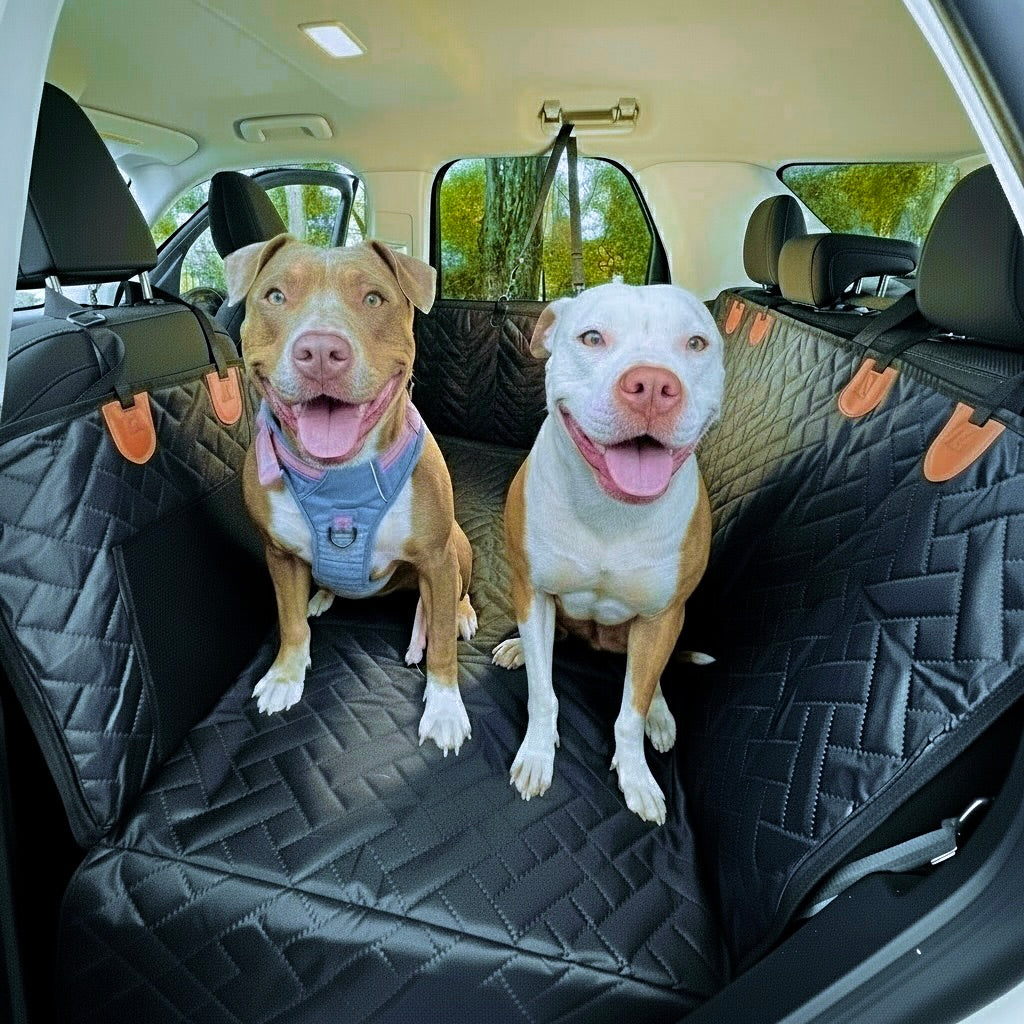
Our own cover is built around a rigid base load-tested to 400 pounds in 100-pound increments, in waterproof 600D Oxford, with metal seat anchors, door protectors, a mesh window, and seatbelt openings that keep a harness usable. It fits two large dogs across a standard bench in trucks, SUVs, and sedans. |
 |
Share