

How to Choose a Dog Seat Cover: What Actually Matters
Choosing a dog seat cover comes down to four decisions: the design that suits your dog's size, whether you need waterproof or water resistant, how the cover anchors to the seat, and whether it leaves seatbelts and child seat anchors reachable. Everything after that is preference.
Most dog seat cover listings compete on the wrong things. Denier numbers, the word "heavy duty," a photo of a golden retriever looking pleased. None of that predicts whether the cover will still be flat, dry, and anchored six months from now.
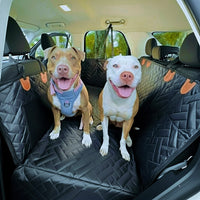
Four things actually decide that: whether it fits your bench, whether the base holds your dog's weight, whether the waterproof layer survives the seams, and whether the anchors hold tension. This guide covers each one, plus what to ask a brand when a listing does not say. If you already know you want a structured option for a larger dog, the Whisker Bark hard bottom dog seat cover is built around those four.
Start With Measurements, Not Style
Every cover in this category is sold as universal, and universal means it fits most. A 62 inch bench and a 48 inch bench are not the same problem, and a few inches decides between a cover that sits flat and one you readjust weekly.
Measure three things before you look at a single product:
- Bench width edge to edge, at the widest point.
- Seat depth from the back cushion to the front lip.
- Footwell drop from the seat edge down to the floor. This is the gap a hard bottom has to bridge, and it varies more between vehicles than anything else.
Our dog seat cover size guide shows exactly where to measure from.
If you would rather skip the tape measure, the Size Fit Checker on our product page confirms compatibility from your vehicle make and model.
Match the Style to Your Dog, Not Your Car
Cover style is usually chosen by vehicle type, which is backwards. The style should follow the problem you are actually solving.
| Style | Solves | Costs you | Right for |
|---|---|---|---|
| Hard bottom | Sag, sliding, unstable footing | Bulk, no front barrier | Large dogs, seniors, two dogs, wide benches |
| Hammock | Front seat climbing, footwell falls | Center sag, blocked buckles | Dogs that push forward, smaller riders |
| Flat bench | Buckle and child seat access | No containment, limited side coverage | Families carrying kids and dogs |
| Cargo liner | Full trunk protection | Dog rides separately from you | SUVs, large breeds, muddy gear |
If your dog climbs into the front seat, buy a hammock. That is the one job a flat cover cannot do, and no amount of structure compensates. Everything else favors a stable base. Our guide to why a hard bottom matters explains the mechanics, and the comparison of hard bottom covers shows how the main brands differ.
Ignore Denier. Look at the Full Stack.
Denier is the single most quoted spec in this category and one of the least useful. Two fabrics both labeled 900D can perform completely differently depending on weave density, fabric weight, and what is bonded underneath.
Covers do not usually fail by ripping. They fail slowly, in four predictable places.
| What you see | Actual cause | What prevents it |
|---|---|---|
| Surface fuzzing, claw scuffs, pilling | Low abrasion resistance, loose weave | Tighter weave, higher fabric weight, reinforced wear zones |
| Water reaching the seat, damp corners | Thin coating, wicking through stitch lines | A bonded film rather than a spray, plus seam placement that blocks wicking |
| Stitching opening, anchors tearing out | Low stitch density, no reinforcement at load points | Bar tacks or box stitching at anchors, durable edge binding |
| Cover drifting, sagging, bunching | Stretchy webbing, strap creep, backing wear | Low stretch webbing, metal hardware, a base that carries load |
A brand that means "heavy duty" literally will reference a recognized test method rather than an adjective. Worth looking for: ISO 12947-2 for abrasion resistance, ISO 13934-1 or ASTM D5034 for fabric strength, and ASTM D1683 for seam failure.
The Waterproof Layer Matters More Than the Shell
Plenty of covers look tough on top and fail underneath. If the waterproof layer is a thin surface coating, it cracks, peels, or pinholes, and mud reaches your upholstery while the outer fabric still looks new.
Three constructions are common. PU coating is flexible and fine when applied thick enough. TPU film laminate resists cracking better than thin coatings. PVC is highly waterproof but can stiffen and crack depending on formulation.
The credible signal is whether a brand cites a hydrostatic pressure method such as ISO 811, because that is a real measurement rather than a marketing word. Our full breakdown of waterproof versus water resistant covers covers which one you actually need, and the FAQ on how waterproof coatings work goes deeper on the chemistry.
Why Covers Slip, and What Actually Stops It
Constant readjustment is the most common complaint in this category, and it almost always traces to one of five causes.
- Slick upholstery. Leather and synthetic leather reduce friction, so lightweight covers slide with nothing to grip.
- Thin unstructured fabric. It folds and bunches under weight instead of staying flat.
- Plastic buckles. They loosen at the webbing over days, especially under a heavy dog.
- Wrong size. A cover too large or too small never anchors correctly no matter how you install it.
- Shallow anchors. Anchors that are not pushed deep into the seat crease pop out on the first jump in.
Four build features counteract all of it: a structured base that stays flat under load, non-slip silicone backing that grips without marking upholstery, metal hardware and low stretch webbing that hold tension instead of creeping, and durable Oxford fabric that keeps its shape rather than folding.
On leather, vacuum the grit out first, since trapped sand acts as an abrasive and reduces how well the backing grips. Our guide to protecting light and leather seats covers that in more detail.
Safety Features Worth Requiring
Four features are not optional if you drive with your dog regularly.
Seatbelt openings that stay usable. This is the one people skip and regret, because the cover is not what protects your dog in a hard stop, the harness is, and a cover that buries the buckle is a cover you quietly stop clipping into. Our guide to stability versus restraint covers choosing a harness and where the independent test data lives.
LATCH access if you also carry kids, since hammock walls commonly sit over the anchors. It is worth confirming your chosen cover allows child seat access safely, and NHTSA guidance on car seat installation explains why unobstructed belt routing matters.
Door protectors for the side panels, which take more mud and scratching than most owners expect. And a mesh window for airflow and visibility, which helps anxious dogs settle.
Matching by Vehicle and Dog
| Your setup | Prioritize |
|---|---|
| Compact car, one small dog | Fit and easy removal. Sag never becomes the problem at this weight. |
| SUV, one large dog | Base structure. Wide benches sag fastest. See the SUV guide. |
| Truck with a split or fold-up bench | Anchor compatibility above all. Many universal covers fail here. See the truck guide. |
| Two dogs sharing a bench | A rigid base. On a tension surface, one dog moving destabilizes the other. |
| Senior or arthritic dog | Flat surface and level entry with no wall to step over. See car setup for arthritis and hip dysplasia. |
| Leather or vegan leather interior | Snug fit and grit control. Drift plus grit is what marks upholstery. See EV and Tesla interiors. |
What to Ask When a Listing Does Not Say
Most brands will not hand you a lab report, but the questions still separate build quality from copywriting. Ask for one verifiable answer in each area, and treat a vague reply as the answer.
- Weight capacity. What is the figure and how was it arrived at? Most brands publish nothing, which is an unknown rather than a reassurance.
- Waterproofing. Coating or bonded film, and how do the seams resist wicking? "Waterproof coating" with no method is a red flag.
- Anchor construction. Ask for a close up of the stitching at the strap points. Refusal is informative.
- The underside. Ask for a photo. "Non slip backing" with no image usually means a thin printed pattern.
- Cleaning. Is the insert removable, and is the fabric machine washable? These are different answers and both matter.
We publish our own answers to all five, including a 400 pound capacity figure and the test that produced it, because most of this category does not. Whether you buy from us or not, hold whoever you buy from to the same standard.
Share