
How to Secure a Dog in a Car: What Actually Works
To secure a dog in a car, use a harness that connects to the vehicle's seat belt, on a surface that does not move underneath them. Never a collar, never a leash clipped to a headrest. No US state requires this, and no federal standard governs the equipment, so the burden of judging it falls on you.
That last part is the uncomfortable bit. There is no agency checking whether the harness on the shelf does anything at all. There is no test a manufacturer must pass before printing "crash tested" on the packaging. The pet restraint aisle is one of the least regulated corners of the automotive world, and most of what is sold there has never been tested by anyone other than the company selling it.
So this guide is less about which product to buy and more about how to tell the difference between a claim that means something and a claim that means nothing.
The Three Things a Setup Has to Do
A dog in a moving car needs three separate problems solved, and most owners solve one and assume they are done.
Stability. The surface under the dog has to stay flat and stay put. This is the layer people skip. A dog sliding on a sagging cover braces for the whole drive, and a restraint attached to a shifting platform starts its work from a worse position.
Connection. Something has to link the dog to the car's own restraint hardware, usually a short tether through the seat belt or a belt routed through the harness itself.
Restraint. A harness that spreads force across the chest and shoulders rather than concentrating it anywhere dangerous.
Miss the restraint and the connection has nothing safe to hold. Miss the connection and the harness is decorative. Miss the stability and you have a dog working to stay upright for forty minutes, which is a comfort and fatigue problem rather than a crash problem, and worth solving on its own terms. Our guide to why a hard bottom dog seat cover matters covers that layer in full.
What "Crash Tested" Actually Means on a Dog Harness
Nothing, on its own. That is not cynicism, it is the regulatory position.
There is no federal motor vehicle safety standard for pet restraints. The National Highway Traffic Safety Administration said so directly in a written interpretation, stating that there are no federal motor vehicle safety standards or regulations applicable to devices of this kind. FMVSS 213, the standard people sometimes reference, governs child restraints. No pet product is required to meet it and none is certified against it by any government body.
What exists instead is a private nonprofit. The Center for Pet Safety was founded in 2011 and writes its own voluntary standard, borrowing FMVSS 213's sled setup and head excursion measurements because there is nothing else to borrow. It is independent of the pet products industry, though worth knowing that its landmark harness study was funded by Subaru. Its certification carries no legal force. It is simply the only outside check that exists.
Three terms get used interchangeably on product pages and they are not the same thing.
| The phrase | What it actually means |
|---|---|
| CPS Certified | Passed the Center for Pet Safety's protocol at an independent lab, and the manufacturer stays enrolled in ongoing monitoring. Publicly listed and verifiable on one page. |
| CPS tested | Appeared in a CPS study. Most products that appeared in CPS studies failed them. This phrase is compatible with catastrophic failure. |
| Crash tested | The brand hired a lab, set its own pass criteria, and published its own result. Unregulated and self declared. Some brands do this transparently. Many disclose nothing. |
The scale of the gap is easier to see in numbers. When the Center for Pet Safety ran its 2013 harness study, twelve harnesses went in and one came out passing. Four failed before they reached the sled. A 2011 pilot round had already produced a complete failure rate across its control group.
Today the certified harness list is short enough to name in a sentence: the Saker Bomber, the Sleepypod Clickit Sport, and the Sleepypod Clickit Range. That is the entire list. Plenty of respectable harnesses are not on it, some because the manufacturer never submitted one, and absence is not proof of failure. But presence is proof of passing, and that asymmetry is the whole reason the list is useful.
One thing worth knowing about the 2013 study: it is thirteen years old, and several products in it have been redesigned since. Read it as the reason the certification program exists rather than as a current verdict on today's market. The current list is the thing to check.
Two Rules That Are Not Negotiable
Never attach anything to a collar. A collar concentrates the entire load on the neck at the moment the dog reaches the end of the tether. This is the single most common mistake and the one with the worst outcome.
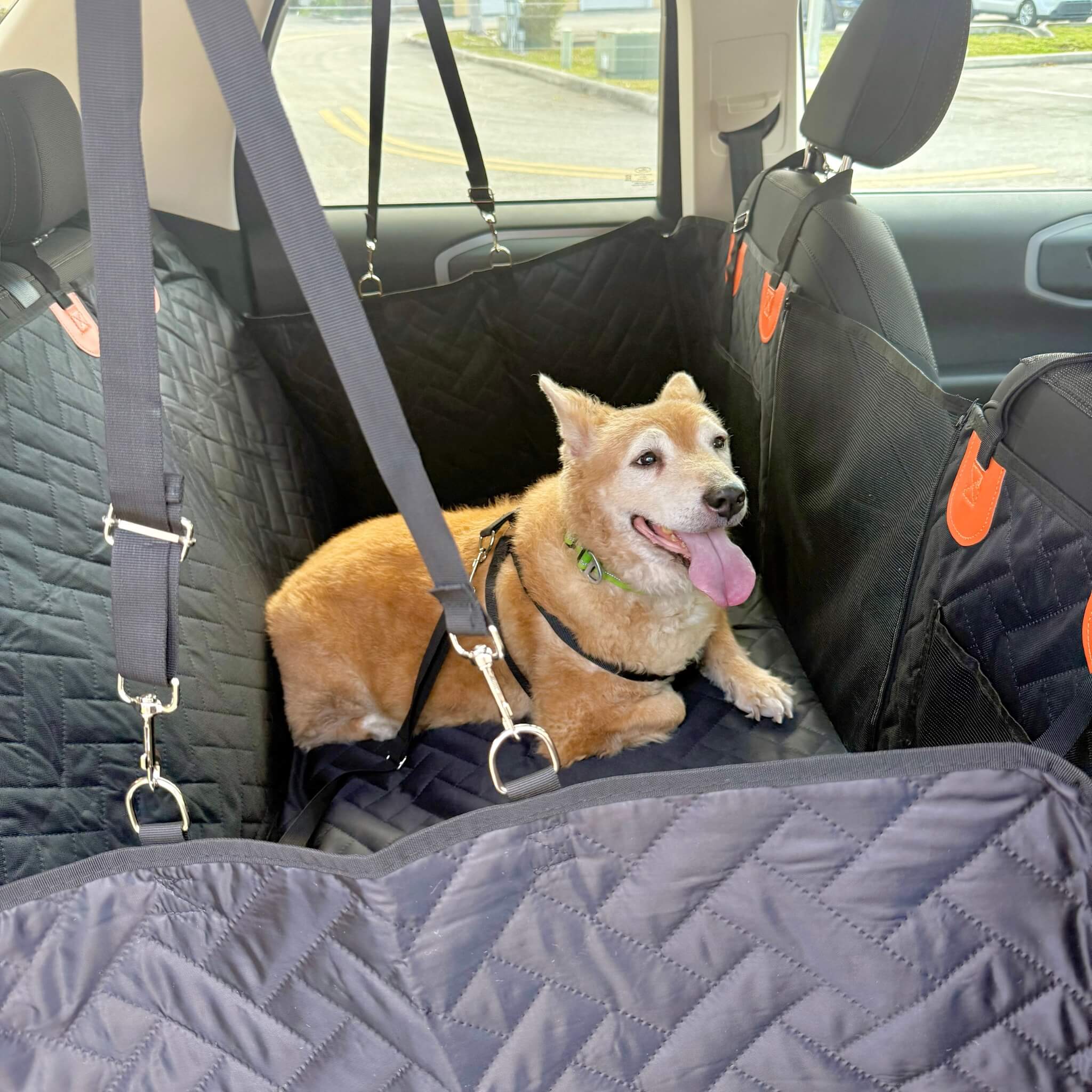
Never treat a tether as the safety device. A tether keeps a certified harness anchored to the car. It is not itself a restraint, and it is not crash tested, ours included. The Whisker Bark seat belt tether exists to make the connection convenient enough that people actually use it, and it does that job. It does not do the harness's job.
The Center for Pet Safety goes further and advises against extension tethers and zipline style products entirely. In one case study, removing an extension tether cut measured head excursion from 74.4 inches to 32.4 inches. Keep slack to a minimum, and keep the connection short.
On veterinary guidance, the American Veterinary Medical Association's policy is unambiguous and worth reading in the original. Its position is that it is unsafe for pets to be loose inside motor vehicles, and that the preferred approach is either a species appropriate enclosure of appropriate size or a properly designed safety harness. Note that it names both. A crate is not a lesser option.
Barriers Are Not Restraints
A cargo barrier keeps a dog out of the front of the vehicle. It does not attach to the dog and it does not control how far they travel forward in a stop. Those are different jobs, and a barrier does not substitute for the second one.
Barriers earn their place in cargo area travel, where the alternative is often nothing at all. But the cargo area brings its own problem: there is frequently nothing suitable to clip to. The Center for Pet Safety has published an explicit advisory on this, warning that cargo area anchors are not always weight rated for the forces an accident generates, and suggesting owners check with the vehicle manufacturer rather than assume. Our SUV and cargo area guide goes into what that leaves you with.
Why the Surface Underneath Is Part of the Answer
Restraint gets all the attention because it is the part that matters in a collision. Stability matters in every drive that is not a collision, which is all of them.
During hard braking, an evasive swerve, or an ordinary city stop, a dog's body keeps moving after the car slows. On a surface that gives way, that momentum turns into sliding, scrambling, and bracing against doors and consoles. None of that is a crash event. All of it is happening on the average Tuesday.
A soft cover makes it worse in a way that is easy to miss. Padding compresses under load, and compression adds travel distance. The more the surface gives, the further the dog moves before anything stops them.
What We Measured, and What It Does Not Prove
Since the category has no standard to point at, we built a repeatable one for the part we can actually control: whether the platform holds.
We used a bench mounted seat simulator with a 52 inch usable bench width, 22 inch seat depth, and a 9 inch footwell drop, on medium firm cushion foam. Load went on through rubber coated plates spread across a 24 by 36 inch plywood distribution panel, in four steps of 100, 200, 300 and 400 pounds, held ten minutes at each step, repeated across three runs. Deflection was measured with a straightedge and tape measure; strap elongation with caliper marks on the webbing.
| Load | Center sag at 1 min | Center sag at 10 min | Front edge drop at 10 min | Strap elongation |
|---|---|---|---|---|
| 100 lbs | 0.2 in | 0.3 in | 0.2 in | 0.1 in |
| 200 lbs | 0.4 in | 0.6 in | 0.4 in | 0.2 in |
| 300 lbs | 0.7 in | 0.9 in | 0.6 in | 0.3 in |
| 400 lbs | 1.0 in | 1.2 in | 0.8 in | 0.4 in |
Figures are averages across three runs. At 400 pounds the platform held at 1.2 inches of center sag after ten minutes under load, against an internal pass threshold of 1.5 inches, with strap elongation of 0.4 inches against a 0.5 inch threshold. After unloading and ten minutes of rest, average remaining sag was 0.4 inches.
Those thresholds are ours. They are not an industry standard, because there is no industry standard, which is the point of the section above.
What this does not prove matters as much as what it does. It is not a crash test and makes no crash claim. It is evenly distributed static weight on a panel, which is not the same as a dog jumping in or bracing on two paws. Three runs on one simulator geometry is a small sample, and real vehicle seats differ in foam, contour, and where straps wrap. It tells you the base does not fold. It tells you nothing about what happens at 30 miles an hour.
What the Law Actually Says
Shorter than most articles suggest: no US state requires a dog to be harnessed, crated, or otherwise restrained inside the passenger compartment of a car. Our full reference on dog car laws by state sets out every statute that does exist, for all fifty states and the District of Columbia.
Bills to create that requirement have been introduced repeatedly and have failed repeatedly, in California, New Jersey, Maine, and most recently Arizona, where a 2025 bill to ban pets on drivers' laps died in chamber. A North Carolina bill filed in 2026 is still sitting in committee.
What does exist falls into two narrow buckets.
Open vehicles. Six states regulate dogs riding in a pickup bed or other open cargo space: California, Connecticut, Maine, Massachusetts, New Hampshire, and Rhode Island. The requirements are similar, usually a cage, an enclosure, cross tethering, or side racks of at least 46 inches, and most carry farm or hunting exemptions. Michigan State University's Animal Legal and Historical Center maintains a reference on these statutes if you want the specifics for your state.
Driver control. Hawaii is the only state with a statute naming an animal in the driver's lap, under Haw. Rev. Stat. section 291C-124, and even that applies only where the animal interferes with control of the vehicle. Washington DC is the only jurisdiction whose distracted driving definition names pets outright.
Everywhere else, an unrestrained dog becomes a legal problem only once it causes you to drive badly, at which point the citation is careless driving, obstruction of view, or failure to maintain control. A few states have charged dangerous transport under animal cruelty statutes, though that is enforcement discretion rather than a traffic rule.
So the honest framing is that this is a safety decision, not a compliance one. Anyone telling you the law requires a dog seat belt is selling something.
Four Setups That Work
One large dog in a back seat. Flat, stable surface across the bench. Rear clip harness with real chest coverage, fitted so you can slide two fingers under the straps and no more. Short tether through the seat belt with minimal slack.
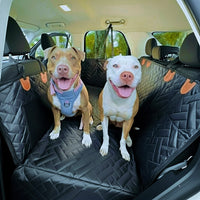
Two dogs sharing a bench. Two harnesses, two tethers, never one shared connection. The surface matters more here than anywhere else, because on a cover that moves, one dog repositioning shifts the footing under the other and neither settles. A flat extended platform removes the footwell they otherwise slide toward.
Senior or mobility limited dog. Enough tether length to lie down comfortably, no more. A flat base with no front wall to climb over. Shorter drives with predictable stops. For dogs with joint conditions, the arthritis and hip dysplasia setup guide goes further.
Cargo area of an SUV. A barrier plus a crate secured to something load rated, not a harness clipped to a cargo hook. This is the setup where checking your vehicle's anchor ratings genuinely matters.
The Mistakes That Undo All of It
- Clipping to a collar. The one with the worst consequences.
- Too much slack. Every extra inch of tether is extra distance travelled before anything stops.
- A harness that fits loosely. Fit changes performance more than brand does. A well fitted uncertified harness beats a certified one worn loose.
- Treating a hammock cover as a safety device. It contains a dog. It does not restrain one.
- Blocked buckles. If the seat belt openings on your cover are awkward, you will skip the clip on short drives, and short drives are most drives.
- A blanket over everything. It slides on braking and undoes the surface underneath it.
The Short Version
Harness, connected to the car's seat belt, on a surface that does not move. Check the Center for Pet Safety's certified list before you believe any packaging, remember that "crash tested" is a self declared phrase with no authority behind it, and do not let anyone tell you the law requires any of this. It does not. The reason to do it is the dog.
Our own contribution to the stability layer is a hard bottom seat cover built around a rigid base, with seat belt openings positioned so a harness stays easy to clip. The load figures above are ours, with the limits stated. The restraint itself should come from the certified list.
Share