

Dog Car Laws by State: What Is Actually Required
No US state requires you to restrain a dog inside the passenger compartment of your car. Not one. What the law actually covers is narrower: two jurisdictions address a dog in the driver's lap, six regulate dogs riding in open truck beds, and twenty make it an offence to leave a dog in a parked vehicle. Everywhere else, an unrestrained dog is legal.
That is not the picture most articles on this subject paint, and it is worth being straight about it, because the case for restraining a dog is a safety case rather than a legal one. The table below covers all fifty states and the District of Columbia, with the statute for every law that exists.
The Headline: There Is No Dog Seat Belt Law
You will see headlines claiming certain states require pets to be harnessed. Every one of them traces back to one of three things: a truck bed law, a general animal cruelty statute written for livestock transport, or a bill that was introduced and never passed.
A few widely shared articles cite cruelty statutes in Michigan, Minnesota and Massachusetts as pet restraint requirements. Read the actual text and they are about carrying animals in a cruel or inhumane manner, aimed largely at livestock hauling. They do not require a harness on a dog in your back seat.
So the honest position is that in forty four states you can legally drive with a dog loose in the car, and in eighteen states there is no vehicle specific animal law of any kind.
Can a Dog Ride in the Front Seat?
Legally, yes, everywhere. No state restricts a dog by seating position, and there is no pet equivalent of the child passenger laws that keep under thirteens in the back.
Two provisions come close without getting there. Hawaii's statute reaches an animal in the driver's immediate area only where it interferes with control of the vehicle. Washington DC treats interacting with a pet as distracted driving regardless of where the pet sits. A dog sitting quietly in the passenger seat breaks neither.
The safety answer is different from the legal one, and it deserves a straight account rather than the usual scare copy. Passenger airbags deploy at somewhere between 100 and 200 miles per hour into a space designed for an adult human. The AVMA, AAA and the Center for Pet Safety all advise against putting a pet there.
What none of them have is data, and that is worth knowing. The AVMA reported in 2023 that no figures exist on how many pets are injured or killed in car accidents at all, because neither NHTSA nor the CDC collects them. So the airbag concern is well reasoned physics endorsed by serious organisations, not a finding from a study. Anyone quoting you a percentage is making it up.
Where all three do agree, and where there is evidence behind it, is restraint. A dog in the back seat, in a crash tested harness connected to the vehicle, is the recommendation. Our adjustable dog seat belt is the tether half of that setup.
The harness half is where most people get caught out, because the phrase crash tested means almost nothing on a label. Our guide to securing a dog in a car covers which ones have actually passed independent testing, and it is a much shorter list than you would expect.
Dog Car Laws by State
Verified August 2026. Statute references are given for every law that exists. Blank means we found no specific statute, not that nothing could ever apply.
| State | Dog in your lap | Dog in a truck bed | Leaving a dog in a parked car | Who may break in to rescue |
|---|---|---|---|---|
| Alabama | No law | No law | No law | No law |
| Alaska | No law | No law | No law | No law |
| Arizona | No law | No law | Illegal (A.R.S. 13-2910) | Any person (12-558.02) |
| Arkansas | No law | No law | No law | No law |
| California | No law | Yes: 46 in racks or cross tether (Veh. Code 23117) | Illegal (Penal Code 597.7) | Any person (Civ. Code 43.100) |
| Colorado | No law | No law | Rescue law only | Any person (13-21-108.4) |
| Connecticut | No law | Yes: must be secured (14-272b) | Rescue law only | Any person (52-557u) |
| Delaware | No law | No law | Illegal (11 Del. C. 1325) | Officers only |
| District of Columbia | Yes: pets named in distracted driving (50-1731.02) | No law | Illegal (8-1808.02) | Officers only |
| Florida | No law | No law | Rescue law only | Any person (768.139) |
| Georgia | No law | No law | Rescue law only | Officers only (35-1-7) |
| Hawaii | Yes: animal in lap or driver area (291C-124) | No law | No law | No law |
| Idaho | No law | No law | No law | No law |
| Illinois | No law | No law | Illegal (510 ILCS 70/7.1) | Officers only |
| Indiana | No law | No law | Rescue law only | Any person, pays half of damage (34-30-30) |
| Iowa | No law | No law | No law | No law |
| Kansas | No law | No law | Rescue law only | Any person (60-5401) |
| Kentucky | No law | No law | No law | No law |
| Louisiana | No law | No law | Rescue law only | Any person (37:1738.1) |
| Maine | No law | Yes: open vehicles (29-A M.R.S. 2087) | Illegal (7 M.R.S. 4011) | Officers only |
| Maryland | No law | No law | Illegal (Transp. 21-1004.1) | Officers only |
| Massachusetts | No law | Yes: 46 in racks or cross tether (c.90 s.22H) | Illegal (c.140 s.174F) | Any person (c.140 s.174F) |
| Michigan | No law | No law | No law | No law |
| Minnesota | No law | No law | Illegal (Minn. Stat. 346.57) | Officers only |
| Mississippi | No law | No law | No law | No law |
| Missouri | No law | No law | No law | No law |
| Montana | No law | No law | No law | No law |
| Nebraska | No law | No law | No law | No law |
| Nevada | No law | No law | Illegal (NRS 202.487) | Officers only |
| New Hampshire | No law | Yes: 46 in racks or secured (RSA 644:8-f) | Illegal (RSA 644:8-aa) | Officers only |
| New Jersey | No law | No law | Illegal (N.J.S.A. 4:22-26) | Officers only |
| New Mexico | No law | No law | No law | No law |
| New York | No law | No law | Illegal (Agric. and Mkts. 353-d) | Officers only |
| North Carolina | No law | No law | Illegal (N.C.G.S. 14-363.3) | Officers only |
| North Dakota | No law | No law | Illegal (N.D.C.C. 36-21.2-12) | Officers only |
| Ohio | No law | No law | Rescue law only | Any person (959.133) |
| Oklahoma | No law | No law | No law | No law |
| Oregon | No law | No law | Rescue law only | Any person (30.813) |
| Pennsylvania | No law | No law | Rescue law only | Officers only (42 Pa. C.S. 8340.3) |
| Rhode Island | No law | Yes: open air vehicles, no neck only restraint (31-22-28) | Illegal (4-1-3.2) | Officers only |
| South Carolina | No law | No law | No law | No law |
| South Dakota | No law | No law | Illegal (SDCL 40-1-36) | Officers only |
| Tennessee | No law | No law | Rescue law only | Any person (29-34-209) |
| Texas | No law | No law | No law | No law |
| Utah | No law | No law | No law | No law |
| Vermont | No law | No law | Illegal (13 V.S.A. 386) | Any person (12 V.S.A. 5784) |
| Virginia | No law | No law | Rescue law only | Officers only (3.2-6504.1) |
| Washington | No law | No law | Illegal (RCW 16.52.340) | Officers only |
| West Virginia | No law | No law | Illegal (W. Va. Code 61-8-19) | No provision |
| Wisconsin | No law | No law | Rescue law only | Any person (895.484) |
| Wyoming | No law | No law | No law | No law |
Truck Beds Are the Real Rule
Six states regulate dogs riding in the open bed of a pickup: California, Connecticut, Maine, Massachusetts, New Hampshire and Rhode Island. This is the only area where a meaningful number of states impose an actual restraint duty.
Four of the six use the same formula, which is worth knowing if you drive a truck. The dog must be in an enclosed space, behind side and tail racks at least 46 inches high, cross tethered to the vehicle, or in a secured container. Massachusetts states it most clearly and carries a minimum fifty dollar fine.
Rhode Island adds a detail the others miss: its statute specifically bars a neck only restraint. A collar tied to the truck bed is not compliance, and it is the exact setup most likely to injure a dog.
Two states, Oregon and Washington, have laws about carrying a dog on the external part of a vehicle, meaning the hood, fenders or running boards. Neither mentions a truck bed, and we would not tell you they cover one.
Lap Dogs and Distracted Driving
Only Hawaii and Washington DC name animals.
Hawaii's is often described as a lap law, and it is narrower than that. The statute bars holding a person, animal or object in your lap or immediate area only where it interferes with your control of the driving mechanism. A calm dog in a lap is not automatically a violation on the face of the statute.
DC's is broader in one sense: its distracted driving definition explicitly includes interacting with pets, alongside reading, grooming and phone use. Where the dog sits does not matter.
Everywhere else, a dog only becomes a legal problem once it causes you to drive badly, and the citation is then careless driving, obstruction of view, or failure to maintain control. Bills to change that have been introduced repeatedly and have failed repeatedly, including in North Carolina in 2025 and New York, where one is still pending.
Parked Cars, and Who Can Break a Window
This is the most legislated area and the most commonly misreported, because two different kinds of law get counted together.
Twenty states plus DC actually make it an offence to leave an animal in a parked vehicle in dangerous conditions. A further thirteen states have a statute that only shields a rescuer from being sued. Those thirteen do not make leaving the dog there illegal, which is a distinction almost no published table draws. Georgia, Virginia and Pennsylvania sit in that group with officer only immunity and no prohibition at all.
On breaking in, fourteen states allow any member of the public to do it with civil immunity: Arizona, California, Colorado, Connecticut, Florida, Indiana, Kansas, Louisiana, Massachusetts, Ohio, Oregon, Tennessee, Vermont and Wisconsin. Eighteen states plus DC restrict it to officers, and eighteen have nothing.
Every one of the fourteen attaches conditions, and the immunity disappears if you skip a step. Typically you need a reasonable belief the animal is in imminent danger, the vehicle must be locked, you must call 911 before entering, use no more force than necessary, leave a note, and stay with the animal until help arrives. Indiana adds a twist: the rescuer is still liable for half the damage to the vehicle.
Our guide to leaving a dog in a parked car covers how fast a cabin actually heats up, which is the part that matters more than the law.
Two Things Worth Knowing About This Table
Laws change, and legislative sessions were active while we compiled this. We have given the statute for every claim so you can check your own state rather than take our word for it, and Michigan State University's Animal Legal and Historical Center maintains the current tables if you want the primary source.
One entry we deliberately did not fill in. Some published lists show Colorado as prohibiting leaving an animal in a parked car. We could only find immunity provisions, not a prohibition, so we have recorded it as a rescue law rather than claim an offence we could not verify.
What the Law Does Not Tell You
The gap between what is legal and what is sensible is wider here than in almost any other area of driving.
A dog is legally allowed to ride loose in the front seat of a car in forty four states. In a thirty mile per hour stop, that dog is an unrestrained mass travelling at thirty miles per hour, and the airbag is designed for something roughly ten times its size. The absence of a law is not evidence that it is fine.
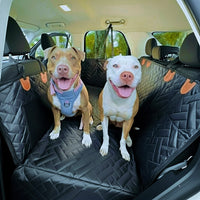
What actually helps is unglamorous: a harness that has been independently tested, a short tether to the vehicle's own belt system, the back seat rather than the front, and a surface the dog can settle on so they are not bracing for the whole drive. That last part is what our hard bottom seat cover is for, and why it has seat belt openings built into it rather than fabric you have to dig under.
The Short Version
No state requires a dog to be restrained inside a car, and no state bans a dog from the front seat. Six states regulate truck beds and that is where the only real restraint duties are. Twenty states make it an offence to leave a dog in a parked car, thirteen more only protect the person who rescues one, and fourteen let any member of the public break a window if they follow the conditions exactly. Check your own state in the table, then ignore the law and use a harness anyway, because the legal floor here is a long way below the safety one.
Share