

Back Seat Extender for Dogs: What It Does and Who Needs One
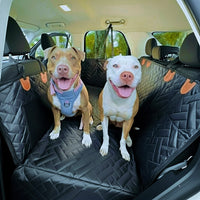
A dog back seat extender is a platform that bridges the footwell so the back seat becomes one flat surface from the seat edge to the front seatbacks. It gives a large dog room to lie down straight instead of curling around a gap, and it stops two dogs sliding into the well on turns.
That gap is usually eight or nine inches deep, and it causes more problems than most owners realize. It is where dogs drift toward on turns, where fabric covers sag into under weight, and where most complaints about an unstable back seat actually start. A hard bottom dog seat cover is an extender that solves it with a rigid base rather than fabric tension.
Below: what an extender does, why it matters more as dogs get bigger, what changes with two dogs or a truck bench, and how the platform is built.
What a Back Seat Extender Actually Does
Two products get sold under this name and they work differently.
A fabric extender is a hammock-style panel that stretches across the footwell, anchored to the headrests. It blocks the gap so a dog cannot fall into it. Under load, it behaves like a sling, because tension is the only thing holding it up.
A rigid extender uses a structural panel that spans the gap and transfers weight into the seat cushion. It creates a genuine platform. The straps hold it in position rather than holding the dog up.
Both stop your dog falling into the footwell. Only one stays flat when a large dog stands on the middle of it. Our guide to why a hard bottom cover matters covers the mechanics of why tension structures give way, and the comparison of hard bottom covers shows which brands use which approach.
Why the Gap Matters More With a Big Dog
Large dogs do two things that expose a weak platform quickly.
They concentrate load. A big dog standing to look out the window puts most of its weight on a small footprint, often right in the middle of the span. That is the worst possible place for a tension structure to take a point load.
They create dynamic force. Bracing on turns, pushing off during entry, and pivoting to resettle all pull against straps and anchors in directions the design did not plan for. A 100 pound dog jumping in delivers a load spike well above its standing weight.
Without a platform that handles both, the same five failures show up:
- Footwell sag. The center dips into the gap, and the surface becomes a slide toward the middle.
- Edge collapse. The front edge folds down when your dog steps in, which unsettles anxious riders and creates a lip to trip over.
- Drift. The cover migrates left or right over a few drives until upholstery is exposed at the edge.
- Seam abrasion. Claws grind into stitching at the front edge and centerline, the two places paws repeatedly land.
- Moisture breakthrough. Wet coats leave the seat damp once the barrier is compromised, usually at those same worn seams.
What Changes With Two Dogs
The problem is not additive. It compounds.
On a tension-based surface, one dog moving redistributes the whole platform. Dog A stands up, the surface shifts, Dog B loses footing and adjusts, which shifts it again. Neither settles, and both keep working for the entire drive. A rigid base breaks that chain, because one dog's movement does not change the floor under the other.
Combined weight matters too. Two large dogs frequently total 140 to 200 pounds, well beyond what most covers are designed around. Most of this category is built for one 40 to 60 pound dog on short trips, which is why a setup that works fine for one dog can fail immediately when a second is added.
Whether Two Dogs Actually Fit
Before buying anything, the honest question is space rather than product. Measure the usable bench width, then each dog across the shoulders while standing.
A 50 inch bench with two dogs measuring 17 and 18 inches across leaves 15 inches of slack, which is comfortable. Add four to six inches of buffer for two dogs and it still works. Add a third dog to that same bench and the combined width plus buffer exceeds what you have, and no cover fixes that.
When the math does not work, zoning beats upgrading. Split the dogs between back seat and cargo area rather than forcing all of them onto one surface. For SUV cargo layouts, our SUV guide covers how to set up both zones.
Trucks and Wide Benches
Crew cab benches are wider than most SUV benches, which makes them the hardest case for a tension-based extender. The wider the unsupported span, the more the middle bellies out under the same load.
Three things stack up in a truck. The bench is wide, so the center span is long. The footwell is deep, so a sagging cover has further to drop. And the entry height is greater, so dogs jump in with more force, which is what pulls anchors out of the seat crease and stretches webbing permanently.
For crew cab, SuperCrew, and Quad Cab layouts, a full-width platform matters more than in any other vehicle, and 60/40 split bench compatibility is worth confirming before you order. Our truck guide covers the bench configurations that defeat covers sold as universal.
How a Rigid Platform Is Built
A structured extender is a stack of parts, each with one job. Knowing what they do makes it easier to tell a real platform from a fabric cover with an insert.
The stability board. A rigid internal panel that spans the footwell and resists center dip. This is the part that determines whether the surface stays flat when a dog stands in the middle of it. Ours measures 54 inches long by 24.8 inches wide by 22 inches high.
The strap system. Metal hardware and low stretch webbing, so tension holds through repeated tightening and real use instead of creeping loose over a week. Plastic buckles are the usual failure point here.
The anti-slip contact layer. Grip material on the underside that reduces lateral migration on smooth or leather seats. Without it, the whole platform walks sideways regardless of how well it is anchored.
The waterproof and abrasion layers. Waterproof 600D Oxford, which handles wet coats and grit while staying practical to clean. Our breakdown of waterproof versus water resistant construction explains why the layer underneath matters more than the fabric on top.
What the Base Holds
Support ratings mean little without the conditions behind them. Ours was measured on a bench simulator across three passes, in staged loads to 400 pounds held ten minutes at each step. At 400 pounds the platform settled 1.2 inches at the center with 0.4 inches of strap elongation. The full protocol, the results at every stage, and an honest account of what a static load test cannot tell you are in our guide to how to secure a dog in a car.
A load rating describes structural stability. It is not a restraint rating and not a crash safety certification, and any brand that blurs those two is worth being skeptical of.
When You Do Not Need an Extender
We sell one, so this section matters more than the rest.
Your dog lies down and stays down. A calm rider who settles immediately never loads the center span hard enough for sag to matter. A standard bench or hammock cover is plenty.
Your bench is already shallow. Some vehicles have a small footwell drop, which means there is barely a gap to bridge. Check yours before assuming you have the problem.
Your dog climbs into the front seat. A flat platform does nothing to stop that. A hammock's front wall is a genuine barrier and the better buy.
Space is the real constraint. Two large dogs on a narrow bench is a zoning problem. A better platform will not create room that is not there.
You remove the cover most days. Rigid panels are bulkier to store, and a cover you stop using protects nothing.
What to Ask Any Brand
If a listing claims no sag or high load support, four questions separate engineering from adjectives.
- What were the test conditions? Bench or real vehicle, distributed or point load, staged or a single number.
- What was actually measured? Sag depth over time, strap creep, edge drop near the footwell.
- What are the stated limitations? Which seat shapes or installs make performance worse.
- Is the safety boundary stated plainly? Any brand that lets a stability rating imply crash protection is telling you something about how it handles claims generally.
Most of this category publishes no weight rating at all, which is an unknown rather than a reassurance. Before ordering anything, check fit with our size guide, and if you are still deciding on style rather than brand, the buying guide covers the wider set of options.
Living With It
Two habits keep a platform working. Push the anchors deep into the seat crease and tighten left and right straps in alternating steps, then recheck after the first two trips, because that is when settling happens. And vacuum the seams weekly, since grit at the front edge and centerline is what grinds through stitching over months. Our cleaning guide covers the routine, and keeping your car clean as a dog owner covers the rest of the interior.
For seniors or heavier dogs, a thin travel blanket on top adds cushioning. Keep it thin enough that it does not reintroduce sliding on top of the platform. Our guide to car setup for arthritis and hip dysplasia goes further for dogs with joint issues.
Two Hazards, Only One of Them Solved
An extender does remove a real hazard. A dog whose front legs drop into the footwell partway through a drive can wrench a shoulder getting out of it, and a nervous dog who does it once will brace for the rest of the trip trying not to repeat it. Filling the gap ends that outright.
It does nothing about the other one. In a sudden stop, a dog on a flat platform travels exactly as far as a dog on a sagging cover, because neither is attached to anything. Those are separate problems with separate solutions, and it is worth not letting the first one make you feel like you have handled the second. Our guide to stability versus restraint covers the second, including how to fit a harness and where the independent crash-test results live.
Share