

Why Whisker Bark Is Built For Big And Multi-Dog Families
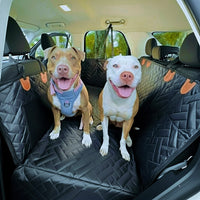
Most dog seat covers are built around one medium dog on short trips. Big dogs and multi-dog households create a different set of stresses: wider bench spans, more shifting, and more “domino movement” when one dog repositions and the other loses footing.
If you are shopping for a stability-first foundation for large or multi-dog rides, start here: hard-bottom dog seat cover for big dogs.
Quick Self Test Are You Outside Typical Cover Limits
- Bench sag: your current cover dips in the middle enough that dogs slide inward.
- Footwell slide: paws drift toward the seat gap or footwell on turns or braking.
- Strap creep: you retighten often, or the cover shifts even after tightening.
- Two-dog instability: one dog jumping in changes the surface under the other dog.
- Replacement cycle: the cover starts “fine,” then becomes looser and less predictable over weeks.
The Four Real Failure Modes For Big And Multi Dog Families
If a cover feels unstable, the culprit is usually one of these. Naming the failure mode makes shopping and setup much easier.
- Span sag: wide benches create a center dip that pulls dogs inward.
- Edge drop: the front edge collapses toward the footwell, so dogs brace to avoid sliding.
- Creep and drift: straps and fabric “settle,” openings shift, and the cover migrates over a few rides.
- Two-dog interference: one dog’s movement becomes the other dog’s footing problem.
Why Weight Capacity Alone Does Not Predict Real Stability
A weight number is only useful if you know the conditions behind it. In real cars, dogs do not apply perfectly even, static weight. They jump in, brace, and shift. That is why stability depends on how the base behaves as a surface, not only on a single capacity claim.
Our In House Stability Check What We Tested And What We Recorded
To make our stability claims more concrete, we ran a repeatable bench test that focuses on sag, edge drop, and strap creep. This is not a crash test, and it is not a restraint certification.
- Sample size: 3 runs on the same seat simulator geometry.
- Seat simulator: 52-inch usable bench width, 22-inch seat depth, 9-inch footwell drop, medium-firm cushion foam.
- Install method: rear headrest straps tightened evenly, seat anchors pushed into the seat crease, underside smoothed flat.
- Load method: rubber-coated plates placed on a 24 in x 36 in plywood distribution panel.
- Load steps: 100 → 200 → 300 → 400 lbs.
- Hold time: 10 minutes per step.
- Tools: tape measure and straightedge for deflection, strap webbing marks for elongation.
Results Snapshot Averages Across 3 Runs
| Load | Center Sag At 10 Min | Front Edge Drop At 10 Min | Net Strap Elongation |
|---|---|---|---|
| 100 lbs | 0.3 in (0.3–0.4) | 0.2 in (0.2–0.3) | 0.1 in (0.1–0.1) |
| 200 lbs | 0.6 in (0.6–0.7) | 0.4 in (0.4–0.5) | 0.2 in (0.2–0.3) |
| 300 lbs | 0.9 in (0.9–1.0) | 0.6 in (0.6–0.7) | 0.3 in (0.3–0.4) |
| 400 lbs | 1.2 in (1.2–1.3) | 0.8 in (0.8–0.9) | 0.4 in (0.4–0.5) |
What Could Change These Numbers
- Seat shape and foam firmness: softer cushions and deeper contours can increase measured sag.
- Install tension: uneven strap tension and shallow anchors often increase drift and edge drop.
- Load pattern: real dogs apply uneven paw pressure and dynamic movement, not evenly distributed weight.
- Wear over time: repeated use, cleaning, and abrasion can change materials and strap behavior.
What To Look For In A Cover When You Have Two Dogs
For multi-dog households, the goal is reducing the domino effect. These are the specs that usually matter most in the back seat.
- A base that stays flatter: less center dip means fewer slips when one dog shifts.
- Anti-drift setup: anchors that stay seated in the crease and straps that hold tension.
- Edge control near the footwell: less drop means less bracing and fewer paw missteps.
- Simple reset ability: if you can tighten and smooth it in 30 seconds, you will actually maintain it.
Setup Rules That Matter More Than Brand Names
Even a good cover can feel unstable if the installation creates drift or buckles become hard to access.
- Seat anchors go deep: shallow anchors pop out and create bunching.
- Straps tighten evenly: uneven tension increases sideways drift over time.
- Check buckle access: if you cannot buckle cleanly every time, the setup will fail on real trips.
- Run a two-trip drift check: align a cover edge to a seat seam, take a photo, then compare after two normal trips.
Safety Notes That Apply To Every Size Dog
A stable surface helps comfort and reduces slipping, but it does not replace restraint. For general travel safety, ASPCA’s guidance is a good starting point: Travel Safety Tips. If you want a crash-test-focused reference list, Center for Pet Safety publishes certified product information for certain harnesses: CPS Approved Harnesses.
Final Thoughts Built For Big And Multi Dog Reality
If you have one very big dog or two dogs sharing the bench, the most important question is not “Does it fit?” It is “Does it stay predictable after two trips, or does it start sagging and drifting?” That is why we publish a repeatable in-house stability check with measurements and limits, not just adjectives.
If you want a foundation layer designed around a hard-bottom platform with waterproof protection and a tear-resistant build for big and multi-dog families, explore the Whisker Bark Hard Bottom Dog Seat Cover.
Share