
We Tested Our Dog Seat Cover To 400 Pounds - Here’s What Happened
Most dog seat covers list a weight limit, but few publish what happened during the test. Below, we share our in-house stability protocol, the measurements we recorded across three runs, and the limits of what those results can prove.
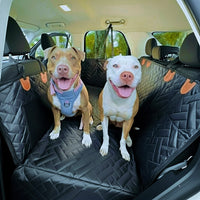
If you want the product referenced in this test, it is here: Whisker Bark 400 lb-rated dog seat cover.
What “Up To X Lbs” Usually Misses
“Up to X lbs” can mean ideal conditions, a quick check, or a best-case scenario that does not reflect real use. For big dogs and multi-dog households, the problem is not only static weight. Dogs jump in, reposition mid-ride, and brace during turns and braking.
Weight Test Timeline
| Stage | Load | Hold Time | What We Checked |
|---|---|---|---|
| 1 | 100 lbs | 10 minutes | Initial sag, strap tension change, anchor settling |
| 2 | 200 lbs | 10 minutes | Base flex vs fabric stretch, edge stability |
| 3 | 300 lbs | 10 minutes | Strap elongation, anchor stress, footwell edge behavior |
| 4 | 400 lbs | 10 minutes | Time-under-load sag, deformation, recovery after rest |
How We Tested A Dog Seat Cover To 400 Pounds
This is an in-house stability check designed to be repeatable. It is not a crash test, and it does not certify safety in a collision.
- Bench-mounted seat simulator: 52-inch usable bench width, 22-inch seat depth, 9-inch footwell drop. Medium-firm cushion foam.
- Install method: rear headrest straps tightened evenly, seat anchors pushed into the seat crease, underside smoothed flat.
- Load type: rubber-coated plates placed on a 24 in x 36 in plywood distribution panel to spread load across the riding surface.
- Load steps: 100 → 200 → 300 → 400 lbs.
- Hold time: 10 minutes per step.
- Trials: 3 repeated runs using the same install procedure.
- Tools: tape measure and straightedge for deflection; caliper marks on strap webbing for elongation.
What We Measured
We tracked five measurements that map to what owners feel in real rides.
- Center sag depth: vertical dip at the center of the riding surface (inches).
- Sag growth over time: center sag at minute 1 vs minute 10 at each load (inches).
- Front edge drop: vertical drop near the footwell edge (inches).
- Strap elongation: net increase in strap length from baseline after each stage (inches).
- Recovery: center sag after unloading and a 10-minute rest (inches from baseline).
Results The Numbers From Our 3 Runs
The table below reports the average across 3 runs, plus the observed range. If you only read one section, read this one.
| Load | Center Sag At 1 Min | Center Sag At 10 Min | Front Edge Drop At 10 Min | Strap Elongation |
|---|---|---|---|---|
| 100 lbs | 0.2 in (0.2–0.3) | 0.3 in (0.3–0.4) | 0.2 in (0.2–0.3) | 0.1 in (0.1–0.1) |
| 200 lbs | 0.4 in (0.4–0.5) | 0.6 in (0.6–0.7) | 0.4 in (0.4–0.5) | 0.2 in (0.2–0.3) |
| 300 lbs | 0.7 in (0.7–0.8) | 0.9 in (0.9–1.0) | 0.6 in (0.6–0.7) | 0.3 in (0.3–0.4) |
| 400 lbs | 1.0 in (1.0–1.1) | 1.2 in (1.2–1.3) | 0.8 in (0.8–0.9) | 0.4 in (0.4–0.5) |
Download The Raw Data And Measurement Notes
To close the gap between “reported results” and “proof,” we publish a plain CSV-style log for each run below. Each line records load, minute mark, center sag, edge drop, and strap elongation.
RUN 1 (bench 52w x 22d, footwell drop 9)
load_lbs,minute,center_sag_in,front_edge_drop_in,strap_elongation_in
100,1,0.2,0.2,0.1
100,10,0.3,0.2,0.1
200,1,0.4,0.4,0.2
200,10,0.6,0.4,0.2
300,1,0.7,0.6,0.3
300,10,0.9,0.6,0.3
400,1,1.0,0.8,0.4
400,10,1.2,0.8,0.4
rest_10min,10,0.4,0.0,0.4

RUN 2
load_lbs,minute,center_sag_in,front_edge_drop_in,strap_elongation_in
100,1,0.3,0.3,0.1
100,10,0.4,0.3,0.1
200,1,0.5,0.5,0.3
200,10,0.7,0.5,0.3
300,1,0.8,0.7,0.4
300,10,1.0,0.7,0.4
400,1,1.1,0.9,0.5
400,10,1.3,0.9,0.5
rest_10min,10,0.5,0.0,0.5

RUN 3
load_lbs,minute,center_sag_in,front_edge_drop_in,strap_elongation_in
100,1,0.2,0.2,0.1
100,10,0.3,0.2,0.1
200,1,0.4,0.4,0.2
200,10,0.6,0.4,0.2
300,1,0.7,0.6,0.3
300,10,0.9,0.6,0.3
400,1,1.0,0.8,0.4
400,10,1.2,0.8,0.4
rest_10min,10,0.3,0.0,0.4
Recovery After Unloading
After the 400-lb stage, we removed the load and let the cover rest for 10 minutes. Average remaining center sag after rest was 0.4 inches (range 0.3–0.5) compared to baseline.
Pass Fail Thresholds We Used
These thresholds are not an industry standard. They are internal decision rules we use to judge whether the platform still behaves like a usable riding surface.
- Center sag at 400 lbs: pass if ≤ 1.5 inches at minute 10.
- Sag growth over time: pass if sag increase from minute 1 to minute 10 is ≤ 0.4 inches at any stage.
- Strap elongation: pass if net elongation is ≤ 0.5 inches after 400 lbs.
- Edge drop: pass if ≤ 1.0 inch at minute 10 at 400 lbs.
What Failed On Typical Tension-Only Hammock Covers
We are not benchmarking a competitor in this post. The section below describes the most common failure modes we see in support when covers rely on fabric tension as the primary “structure.” Treat this as pattern guidance, not comparative test proof.
- Center-pocket formation: the span dips, pulling dogs inward.
- Progressive loosening: tension changes over a few rides as straps and fabric settle.
- Edge drop toward the footwell: the front edge droops and dogs start bracing.
- Permanent set: the cover stays more deformed even after the dog gets out.
What This Test Does Not Prove
- No crash safety claim: this is not a restraint test. Use an appropriate travel harness or crate setup per general safety guidance such as the ASPCA travel safety tips.
- Not every vehicle seat matches our simulator: seat foam, contours, and strap wrap zones change results.
- Dynamic loads can be higher: bracing, jumping, and uneven paw loading are not identical to evenly distributed weight on a panel.
- Limited sample size: this was 3 runs on one simulator geometry. Results vary with install tension, seat shape, and use patterns.
What This Means For Big Dogs And Multi-Dog Households
If your goal is “less sliding, less bracing, less constant adjustment,” a weight test is only useful when it shows how much the surface dips and whether it keeps dipping over time. In our in-house setup, the platform stayed within our pass thresholds at 400 pounds with 1.2 inches of center sag at minute 10, plus limited strap elongation.
Final Thoughts
If a brand claims a rating, the most credible version of that claim includes the setup, the hold time, the number of runs, the thresholds, and the raw log. That is the standard we are aiming to meet here.
If you want the product referenced in this test, here it is: Whisker Bark tear resistant dog seat cover.
Share