

Dog Travel Essentials: What to Actually Pack
The gear that actually matters for travelling with a dog is short: something to keep them stable and restrained, water they can drink at a rest stop, a way to clean up what happens, and their own medication and records. Everything else on the usual twelve item list is comfort, and comfort is optional in a way the first four are not.
Most packing lists are written to be long. This one is ordered by what goes wrong if you forget it, which is a more useful sort order when you are loading the car at six in the morning.
Before You Load Anything
Four things to settle in the days before, not the morning of.
- Check the microchip registry. Not the chip, the registry entry. A chip pointing at a phone number you had two moves ago is the single most common failure in a lost dog case, and it takes two minutes to fix.
- Vet visit if anything is due. Vaccinations current, and a conversation about motion sickness if your dog has a history of it. Some options need to be given well before departure rather than in the car park.
- Copies of the records. Photograph the vaccination card. Hotels, campgrounds, daycare and some parks ask, and an emergency vet in another state will want history you cannot recite from memory.
- A recent photo of your dog. On your phone, taken this month. If you need it, you will need it immediately and you will not want to be scrolling.
The Four That Actually Matter
Somewhere stable to sit
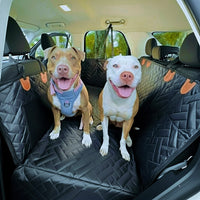
The back seat is not a surface a dog can settle on. It slopes, it is slick, and there is a drop into the footwell that a sleeping dog will find. The point of a seat cover is not really cleanliness, it is giving the dog a flat surface that does not move so they lie down instead of bracing for the whole drive.
Our Dog Seat Cover with Hard Bottom is $129.95 and is built around a rigid base for that reason, with a waterproof surface and door protection. It ships with a seat belt tether included, so you do not need to buy that separately.
Why the rigid base changes how a dog rides, rather than just how the seat looks afterwards, is covered in our guide to hard bottom seat covers.
If your dog rides in the cargo area instead, the Waterproof Dog Trunk Cover at $48 covers the load floor and the sides, which is where wet dogs actually make contact.
A harness, and something to clip it to
A dog loose in a moving car is unrestrained in the only sense that matters, and no seat cover changes that. The harness is the restraint. A tether is what connects it to the car's own seat belt.
Ours is the Dog Adjustable Seat Belt for Car at $12, and it comes free with the seat cover. What it is not is a crash tested device, and neither is anyone else's tether.
That distinction matters more than the tether itself. Most of what is sold as crash tested has never been tested by anyone but the company selling it, and only three harnesses on the market have passed independent certification. Which ones, and why the phrase means so little, is in our guide to securing a dog in a car. Worth reading before you buy a harness.
Water they can actually drink
A dog will not drink from a bowl sliding around a rest stop kerb, and a water bottle you have to pour into your cupped hand wastes most of it. Two formats, different jobs.
The Portable Dog Water Bowl at $18 is the non spill version, for in the car and at rest stops where you have somewhere to set it down.
The Portable Dog Water Bottle and Bowl at $12 puts the reservoir and the drinking trough in one unit, which is what you want on a trail or a walk where there is no flat ground and nothing to balance a bowl on.
Offer small amounts often rather than a large drink at long intervals. A dog that gulps a full bowl after three hours is more likely to bring it back up on the next stretch of road.
Cleanup, kept within reach
Not in the boot under the luggage. In the door pocket or on the seat beside you, because the moment you need it you will be on a hard shoulder.
Wipes, a dedicated towel, poop bags, and a bag for anything wet or muddy that cannot go back in with the clean things. That is the whole kit. Two towels is better than one: one for the coat, one for paws, which stops you spreading mud around while trying to remove it.
Worth Packing, Not Worth Stressing About
A blanket or bed that smells like home. The value is scent rather than padding. An unfamiliar hotel room is easier with something that smells right, and it is the cheapest anxiety intervention available.
A chew or a puzzle toy. Useful at the destination more than in the car. A dog with something to do in a strange room settles faster than one watching the door.
A first aid kit. Bandage material, antiseptic wipes, tweezers for ticks, and whatever your dog is prescribed. Ask your vet what they would add for the kind of trip you are taking, since a beach week and a mountain week have different answers.
A spare leash and a spare ID tag. Both weigh nothing. A broken clip two states from home is a genuinely bad afternoon.
Two Categories Worth Understanding Before You Buy
We do not sell either of these, so take this as guidance rather than a recommendation.
Crates and carriers. If your dog travels in a crate, it has to be secured to the vehicle or it becomes a large loose object. Look for airline compliance if flying is ever part of the plan, ventilation on more than one side, and a size that lets the dog stand and turn. A crate that is too large is worse than one slightly snug, because there is more room to be thrown around inside it.
Dog packs. Fine for a hiking dog, useless for a car trip. If you buy one, the fit matters more than the capacity, and the load should sit over the shoulders rather than the lower back. Build up to weight gradually rather than loading it fully on the first walk.
If Your Dog Is Older
Long drives are harder on senior dogs than the mileage suggests, because a dog on an unstable surface spends the whole trip holding themselves in position. That is the main argument for a flat, stable base rather than a soft one, and it is why stiffness on arrival is so common.
Two things worth thinking about beyond the car itself.
Routines get dropped when travelling. If your dog has a regular post activity routine at home, whatever it consists of, the trip is when it quietly stops happening. Ours includes a red light therapy device at $149.95, which is portable enough to pack if it is already part of what you do. If it is not part of your routine, a trip is not the moment to start something new.
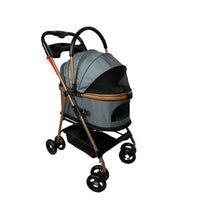
And mobility at the destination is a separate problem from mobility in the car. A dog who manages the house fine can struggle with a day of walking on unfamiliar ground. Our Luxury Pet Stroller at $155 exists for that gap, for small and older dogs who want to come along but cannot do the whole distance.
The Checklist
| Do not leave without | Pack if there is room |
|---|---|
| Harness and tether | Blanket or bed from home |
| Seat cover or cargo liner | Chew or puzzle toy |
| Water and a bowl | Crate or carrier |
| Food, measured out by day | Spare towel |
| Medication | Brush |
| Poop bags and wipes | Long line for unfenced spaces |
| Vaccination records | First aid kit |
| Spare leash and ID tag | Portable shower or rinse bottle |
Measure food out by day into separate bags before you go. It takes five minutes at home and removes the one decision nobody wants to make in a motel car park at eleven at night.
On the Road
Stop every two to three hours. Not only for the dog, though it helps them, but because a dog who has moved recently settles better for the next stretch.
Keep the cabin cooler than you would for yourself. Dogs shed heat far less efficiently than people do, and a temperature that feels mild in the front seat can be uncomfortable for something wearing a coat in direct sun through a rear window.
Never leave a dog in a parked car. It is repeated so often that it has stopped registering, and it remains the way most heat related deaths in dogs happen. On a warm day the interior climbs faster than almost anyone expects, and cracked windows change it very little.
If your dog gets carsick
Feed a light meal several hours before departure rather than travelling on either a full or an empty stomach. Face them forward if you can, since watching the world go sideways makes it worse. Fresh air helps more than air conditioning. And if it happens on every trip rather than occasionally, that is worth a conversation with your vet, because there are prescription options that work well and it is not something a dog has to simply endure.
Nervousness and motion sickness look similar from the front seat and have different solutions, which our guide to dog anxiety in the car goes into.
The Short Version
Restraint, a stable surface, water, and cleanup. Those four cover most of what goes wrong. Sort out the microchip registry and the vaccination records before you go, keep the cleanup kit within arm's reach rather than in the boot, portion the food out by day, and stop every couple of hours. The rest of the list is comfort, and you can add it a trip at a time as you find out what your dog actually cares about.
Share