

Dog Breeds Prone to Hip Dysplasia: What the Rankings Do and Do Not Tell You
The breeds most affected by hip dysplasia are large and giant ones: German Shepherds, Golden and Labrador Retrievers, Rottweilers, Newfoundlands, Saint Bernards, Bernese Mountain Dogs, Bullmastiffs and Great Danes. That much every page on the subject agrees on.
What those pages usually skip is that the breed rankings they quote come from a database that undercounts the problem, that size predicts something different from what people think it predicts, and that several of the highest risk breeds have improved dramatically in the last thirty years. All three change what you should do with the information.
What the Largest Study Actually Found
The most comprehensive look at this interrogated the full Orthopedic Foundation for Animals database: 1,056,852 hip evaluations across 60 breeds, from 1970 to 2015.
The five breeds with the most severe hip dysplasia in that dataset were the Newfoundland, the Bloodhound, the American Staffordshire Terrier, the Bullmastiff and the Rottweiler.
At the other end, four breeds came in under 4 percent: the German Shorthaired Pointer, the Flat Coated Retriever, the Belgian Tervuren and the Belgian Sheepdog. Three of those four are large dogs, which is the first hint that size alone is not the story.
A separate UK primary care dataset ranked things slightly differently by looking at osteoarthritis rather than hip scores, putting the Rottweiler at roughly three times the odds of a crossbreed, with the Dogue de Bordeaux and Old English Sheepdog close behind.
What Size Predicts, and What It Does Not
The systematic review of osteoarthritis risk factors is the cleanest measurement of this, and its answer is more specific than "big dogs get it".
A systematic review of osteoarthritis risk factors put numbers on the size effect: large breeds carried roughly 3.6 times the risk and giant breeds roughly 10.2 times, while small and medium breeds came in at 0.2, which is to say protected.
So the size effect is real and it is large. But it is worth being precise about what it is measuring, because Merck states that hip dysplasia is most common in large breed dogs and then adds that it can also affect small breed dogs and cats.
Merck is the source for that qualification, and it is not a throwaway line.
The useful way to hold both facts at once is this. Conformation and breeding largely determine whether a hip develops badly. Size largely determines whether a badly developed hip goes on to hurt. A small dog carries far less load across a shallow socket, so fewer small dogs become visibly lame, which also means small breed cases are underdiagnosed rather than absent.
Some of the highest rates in OFA's own breed statistics belong to breeds nobody would guess, including the Bulldog and the Pug. If you own a flat faced or short legged breed and have been told hip dysplasia is a big dog problem, that is worth checking for your own breed at ofa.org.
Why the Breed Percentages You Read Are Too Low
This is the part almost nobody mentions, and it should change how you read any breed ranking.
OFA data is submitted voluntarily. A review of 431,483 OFA evaluated dogs made the consequence explicit: owners of animals whose radiographs are likely to be classified as dysplastic may simply not submit them, so the results cannot be generalised to the entire dog population.
In other words the published percentages describe screened, mostly breeding stock dogs whose owners expected a decent result. The true breed rates are higher than the table says, and by an unknown amount.
Two practical consequences. A breed near the bottom of the ranking is not safe, it is less screened or better selected. And a breeder telling you their line is clear is making a claim about the dogs they submitted.
The Numbers Are Moving, and Fast
Here is the genuinely encouraging part. Where a country has run consistent breed screening for decades, the rates have fallen sharply. Swiss data covering 1995 to 2016:
| Breed | 1995 | 2016 |
|---|---|---|
| German Shepherd Dog | 46.2% | 18.0% |
| Golden Retriever | 25.3% | 9.4% |
| Bernese Mountain Dog | 21.2% | 12.5% |
| Labrador Retriever | 16.5% | 2.9% |
| Flat Coated Retriever | 6.0% | 2.6% |
Those are proportions of screened dogs classified as dysplastic, so the same self selection caveat applies to both columns. The direction is what matters, and it holds across the OFA data too, where the same 60 breed analysis found overall improvement in hip conformation over the period.
The reason to know this is that it tells you where your leverage is. A Labrador from a screened line in 2026 is a very different bet from a Labrador in 1995. A Labrador from an unscreened line is not.
What to Ask a Breeder
Breed is the coarse filter. The line within the breed is the fine one, and it is the part you control.
Ask for documented hip results on both parents. Then ask for the results on previous litters and on siblings, because progeny data tells you more about what a dog passes on than that dog's own grade does. A breeder who cannot produce either is answering the question.
Ask whether the dogs have been PennHIP tested rather than only OFA graded. PennHIP measures laxity numerically and can be done from sixteen weeks, where OFA does not certify until twenty four months. For an at risk breed that gap matters, because the surgical options that can still change the shape of a hip close at around twenty weeks.
And know that a good result is not a guarantee. Normal hipped parents can produce affected offspring, which is what makes progeny data worth asking for.
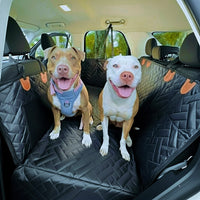
For the giant breeds in particular, the practical daily problem is usually getting in and out of the car rather than the walk itself, which our car setup guide for dogs with hip dysplasia deals with.
German Shepherds Are a Separate Case
Two things make this breed different enough to need its own page. The risk curve is shifted, so a given laxity measurement carries more osteoarthritis risk in a German Shepherd than in other breeds. And this is the breed most associated with degenerative myelopathy, a spinal cord disease that looks like hip dysplasia early on and is treated completely differently.
Our guide to hip dysplasia in German Shepherds covers both, including how to tell the two conditions apart at home.
If Your Dog Already Has It
Breed risk stops being useful the moment you have a diagnosis, because from that point the levers are the same for every breed and the biggest one is weight. Equipment, including a dog wheelchair for back legs, comes a long way down that list.
The order that actually matters is weight, then pain control, then traction and ramps, then equipment.
What the signs look like as they progress, how it gets diagnosed, and what the evidence says about treatment and supplements is all in our guide to hip dysplasia in dogs.
Breed risk is a starting position rather than a verdict, and the dogs that do worst are usually the ones whose owners were reassured early.
And if the hind end has reached the point where it cannot reliably carry weight, the Whisker Bark adjustable dog wheelchair adjusts across height, length and width, which matters more in this category than in most because the breeds on this page span a Pug to a Newfoundland.
Share