

Are Dogs Allowed in Home Depot?
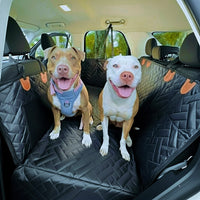
Home Depot allows leashed, well behaved dogs in most stores, and it is one of the few large chains where the practical answer is genuinely yes rather than a technicality.
What it does not have is a published national policy saying so. That gap is the reason every article on this question disagrees with every other one, and it is worth understanding before you drive over.
Does Home Depot Allow Dogs?
In practice, yes, in most locations. We went looking for an official Home Depot pet policy and could not find one published anywhere. What exists is a consistent, decades old practice of store managers welcoming leashed dogs, which is a different thing from a rule you can point at.
So the honest answer is that your local store almost certainly allows it, and no one can promise you that in advance, including us.
The Rule That Predicts Every Store
Here is the thing that explains the whole category, and almost nobody writing about it mentions it.
Whether a shop lets your dog in is mostly predicted by whether it sells food.
Every state adopts some version of the FDA Food Code. Its rule on animals, section 6-501.115, says live animals may not be allowed on the premises of a food establishment, with an exception for service animals under the control of a person with a disability in areas usually open to customers.
Home Depot sells lumber, paint and appliances. It is not a food establishment, so that regulation does not bind it, and there is nothing forcing a manager's hand.
Compare it with Target, which sells groceries and is therefore inside the rule. Same question, opposite answer, and the difference is the aisle layout rather than the company's attitude to dogs.
Is Home Depot Dog Friendly?
More than most, and with real caveats that have nothing to do with policy.
A Home Depot is a working warehouse. There are forklifts operating in the aisles, pallets being moved, timber being cut, dropped screws and nails on the floor, and spills of things you would not want a dog to lick. It is dog friendly in the sense of being permitted, not in the sense of being a safe playground.
The busy hours are the ones to avoid, and the lumber and garden ends of the store are where the machinery is.
What the Rules Are When You Are There
Nothing formal, which means the unwritten ones matter more.
Keep the dog on a short lead rather than a retractable one, because an extended lead across an aisle is exactly what a forklift driver cannot see. Keep it out of the way of staff moving stock. Do not let it sit in the flatbed trolley, which is a real hazard on a moving cart. And clean up anything that happens, immediately.
A dog that barks at other customers is the fastest way to turn a relaxed store into one with a new rule.
How to Check Before You Drive Over
With no national policy, the only reliable answer comes from the store you are actually going to.
Ring the branch and ask whether they allow leashed dogs. It takes a minute, it gets you a real answer for that location, and it avoids the version where you arrive with a dog in the car and have to decide what to do with it.
Ask about the specific store rather than the chain, because the person answering can only speak for their own floor. And be aware the answer can change with a new manager.
Can Home Depot Refuse My Dog?
Yes, for a pet, and at any time. With no published policy there is nothing to appeal to, and a manager who decides against it is within their rights.
A service animal is different. Refusing a trained service dog is a legal matter rather than a discretionary one.
Can Home Depot Ask for Proof of a Service Dog?
No, and the limits are tighter than most shoppers or most employees realise.
Where it is not obvious what service the dog provides, staff may ask exactly two questions:
- Is the dog a service animal required because of a disability?
- What work or task has the dog been trained to perform?
That is the whole list. Staff may not request documentation, require the dog to demonstrate its task, or ask about the nature of the person's disability.
Taking a Puppy to Home Depot
This is one of the genuinely good uses of the store, and a common one.
A hardware store is a busy environment with trolleys, strangers, echoing noise and hard floors, and no food on the shelves to complicate matters. For socialising a young dog to a chaotic indoor space, it is close to ideal.
Keep the sessions short, go at a quiet hour, and leave before the puppy is overwhelmed rather than after.
Dogs in Trolleys and Strollers
Nobody is checking, because there is no rule to enforce. The question is what is actually safe.
A flatbed lumber trolley is not a dog carrier. It has no sides, it is designed to be pushed at speed, and a dog stepping off one at the wrong moment is how a leg gets broken.
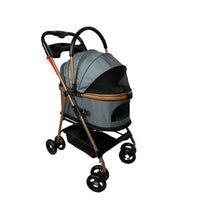
A dog stroller is the version of this that works, and hardware stores are one of the places it genuinely belongs, along with garden centres, pet shops and outdoor markets.
The shops it suits are the ones with no food on the shelves, which is the same test from earlier running in reverse.
Our guide to which shops allow dog strollers covers where that does and does not hold.
If Your Dog Cannot Manage the Whole Trip
Older dogs that used to come along tend to get left at home once a full lap of a warehouse becomes too much, which is usually the point at which the outings stop altogether.
Hard concrete floors are also the worst surface for a dog with a weak back end, and a slip on polished concrete is not a small thing for an arthritic dog.
The Whisker Bark luxury pet stroller folds flat for a boot and covers over in weather, which is what keeps a slower dog in the trip rather than out of it.
When a Service Dog Can Be Asked to Leave
Two situations, and they apply to genuine service animals as much as to anyone else.
A dog that is out of control while the handler takes no effective action to control it, and a dog that is not housebroken.
In either case the business can ask for the animal to be removed and must still offer to serve the person without the dog present.
Do Staff Actually Enforce Anything
Rarely, and the exceptions are predictable.
What gets a dog asked to leave is almost never its presence. It is barking, lunging, an accident on the floor, or a lead stretched across an aisle where a machine is operating. Stores that tighten up have usually had one of those happen recently.
Which means the behaviour of the dogs that went in before yours has more bearing on your welcome than any policy does.
Where Home Depot Sits Against Other Chains
Broadly, the shops that sell no food are relaxed and the ones that sell food are not.
Home Depot, Lowe's and most garden centres fall on the permissive side. Walmart and Target sell groceries and hold the line at service animals. Costco sells food and samples it, and is stricter still.
None of which is a promise about the store nearest you. It is the pattern underneath the contradictions.
Share