

Are Dogs Allowed in Target?
Trained service dogs are allowed in Target. Pets are not, and that includes a small dog carried in your arms, zipped into a carrier, or sitting in a stroller.
What makes this confusing is that plenty of people have walked a dog through a Target without being stopped. Both things are true at once, and the reason why is the useful part of this page.
Does Target Allow Dogs?
Only service animals. Target does not publish a pet policy page the way Walmart does, which is worth knowing before you trust any article claiming to quote one. We went looking for an official Target statement and could not find a public one.
What does exist, and what actually governs, is two pieces of law that apply to Target whether or not the company writes anything down.
The Rule That Predicts Every Store
Here is the thing almost no article about this mentions, and it explains why the answer differs from shop to shop.
Whether a store lets your dog in is mostly predicted by whether it sells food.
Every state adopts some version of the FDA Food Code. Its rule on animals, section 6-501.115, reads: live animals may not be allowed on the premises of a food establishment, with an exception for service animals under the control of a person with a disability in areas usually open to customers.
Target sells groceries. That puts its stores inside that rule in most jurisdictions, and it is why the answer at Target is firmer than the answer at a hardware store, which sells no food and is bound by no equivalent regulation.
So when you read one article saying dogs are welcome and another saying they are banned, they are usually both reporting real experiences at different kinds of shop, without the rule that separates them.
Is Target Dog Friendly in Practice?
Inconsistently, and that inconsistency is not your imagination.
Enforcement sits with the individual store, which means it varies by location, by manager, by how busy the shop is and by who happens to be near the door. A small dog in a stroller in a quiet suburban store on a Tuesday morning attracts less attention than a large dog on a lead at 5pm.
Being allowed through the door is not the same as being permitted, though. If a team member asks you to leave with your pet, they are on solid ground, and there is no policy to appeal to.
What Counts as a Service Animal
The Americans with Disabilities Act defines a service animal as a dog that has been individually trained to do work or perform tasks for a person with a disability, and the task has to be directly related to that disability.
Guiding someone who is blind, alerting someone who is deaf, retrieving items for someone with limited mobility, alerting to an oncoming seizure, interrupting a panic attack with a trained action. The common thread is a trained task, not the dog's presence.
Miniature horses get a separate accommodation under the ADA. No other species qualifies.
Are Emotional Support Animals Allowed in Target?
No, and this catches a lot of people out.
The ADA is explicit that animals providing comfort simply by being present do not meet the definition, because comfort is not a trained task. An emotional support animal has real standing in housing law and had standing in air travel law for years, and neither of those carries over to a shop floor.
A letter from a doctor, a vest bought online, and a certificate from a registry all change nothing here. There is no federal service dog registry, and the ones selling certificates are selling paper.
What About Service Dogs in Training?
Not covered federally. The ADA states that the dog must already be trained before it can be taken into public places.
Some states do extend access rights to dogs in training and their handlers, so this is genuinely a state by state question rather than a settled national one. If you are training a dog, check your own state's law rather than assuming either answer.
Can Target Ask for Proof of a Service Dog?
No, and the limits on what staff may ask are tighter than most shoppers or most employees realise.
Where it is not obvious what service the dog provides, staff may ask exactly two questions:
- Is the dog a service animal required because of a disability?
- What work or task has the dog been trained to perform?
That is the whole list. Staff are not allowed to request documentation, require the dog to demonstrate its task, or ask about the nature of the person's disability.
Which is exactly why the rule is so easy to abuse, and why staff are often unsure what they are permitted to do. Neither of those is a reason to bring a pet.
Can I Take My Dog to Target in a Stroller or a Cart?
A stroller does not convert a pet into a service animal, and the food code makes no exception for a dog that is off the floor. The rule is about the animal being on the premises, not about what it is standing on.
In practice a covered stroller draws less attention, which is why so many people report getting away with it, and why the question gets asked so often.
Where a dog stroller genuinely earns its place is everywhere else in the trip: pet shops, garden centres, hardware stores, outdoor shopping streets and farmers markets.
Those are the places with no food on the shelves, which is the same rule from earlier running in reverse.
Our guide to which shops allow dog strollers goes through where it works and where it does not.
Can I Bring a Puppy to Target?
No, and the answer does not soften because the dog is small or new.
A puppy is a pet, and a puppy being socialised is not a service dog in training in any sense the ADA recognises. Pet shops, garden centres and hardware stores are the usual places people take a young dog for busy-environment practice, and those work for the reason set out above.
If Your Dog Cannot Walk the Whole Trip
This is the version of the question we get asked most, and it does not change the answer at Target. A dog with arthritis, a spinal condition or a back end that tires after twenty minutes is still a pet under the rule, however genuine the need.
What it does change is everywhere else. A dog that has stopped managing a full outing is often withdrawn from trips altogether, and wheels are what keep it coming along.
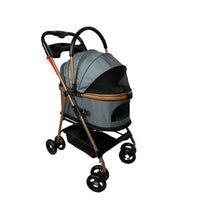
The Whisker Bark luxury pet stroller folds flat for a boot and has a zip cover for weather, which is worth more on a long day out than at any shop door.
When a Service Dog Can Be Asked to Leave
Two situations, and they apply to genuine service animals as much as to anyone else.
A dog that is out of control while the handler takes no effective action to control it. And a dog that is not housebroken.
In either case the shop can ask for the animal to be removed, and must still offer to serve the person without the dog present. A service dog barking at other shoppers or lunging on its lead is a dog that can lawfully be asked to leave.
Why the Restriction Exists at All
It is not really about your dog, which is the part owners find hardest.
Food contamination is the regulated reason. Beyond that, shops are balancing customers with genuine dog allergies, customers with a real fear of dogs, the risk of a bite in a crowded aisle, and the practical mess of an accident on a shop floor.
There is also a knock-on effect that matters to anyone who actually depends on a dog. The more pets that come through as service animals, the more suspicious staff become of every dog, and the people who pay for that are the ones with a trained task-performing dog who now get questioned at the door.
If You Are Taking a Service Dog In
A few things make the trip easier for everyone.
Keep the dog on a lead or harness unless a device would interfere with its work. Keep it close rather than letting it range across the aisle. Do not let it sample anything, sniff produce or ride in the trolley basket.
Know your two answers before you are asked, and give them plainly. Staff asking are usually doing their job rather than challenging you.
And if a team member gets the rules wrong, asking for a manager settles it faster than arguing at the entrance. Most of these situations are training gaps rather than hostility.
Share