

Are Dogs Allowed in Whole Foods?
Only service animals are allowed inside Whole Foods. Pets are not, however many you have seen in the aisles of your local store.
The gap between the rule and what people actually do is wider at Whole Foods than almost anywhere else, and it is worth understanding why before you assume the store you are going to will be relaxed about it.
Does Whole Foods Allow Dogs?
Service animals only. We went looking for an official published Whole Foods pet policy and could not find one, which puts it in the same position as most large retailers and unlike Walmart, which does publish one.
The absence of a published policy does not create permission here, though, because a grocer does not need a company rule to say no. The law already does.
The Rule That Decides It
Whether a shop lets your dog in is mostly predicted by whether it sells food.
Every state adopts some version of the FDA Food Code. Its rule on animals, section 6-501.115, states that live animals may not be allowed on the premises of a food establishment, with an exception for service animals under the control of a person with a disability in areas usually open to customers.
Whole Foods is a grocer with open produce, a butcher counter, a fishmonger, hot food bars and prepared meals. It is a food establishment several times over, and there is no version of the rule that lets a pet onto that floor.
Then Why Do I See Dogs in Whole Foods?
Because enforcement is a person's decision and the rule is not.
Whole Foods stores skew urban, sit in neighbourhoods with high dog ownership and a lot of foot traffic, and are staffed by people who mostly do not want a confrontation at the entrance over a small dog in a bag. So the rule goes unenforced far more often than it is applied.
That is not the same as being allowed. A member of staff asking you to leave with a pet is applying the rule correctly, and there is nothing to appeal to.
The Patio Exception
This is the part worth knowing, because it is real and it is written into the same regulation that bans dogs indoors.
Many jurisdictions have adopted provisions permitting dogs in the outdoor areas of a food business, subject to a permit and conditions. Where your local authority has adopted that, a Whole Foods with outdoor seating can legitimately allow a dog at an outside table while still refusing one inside.
It varies by state and by city, which is why the answer changes when you travel. If a store has a patio and a dog bowl by the door, that is usually why.
What Counts as a Service Animal
The Americans with Disabilities Act defines a service animal as a dog individually trained to do work or perform tasks for a person with a disability, directly related to that disability.
Emotional support animals do not qualify, because comfort is not a trained task. Dogs in training are not covered federally, though some states grant access rights separately.
A vest, a doctor's letter and an online certificate carry no weight in a shop. There is no federal service dog registry, and the sites selling certificates are selling paper.
Can Whole Foods Ask for Proof of a Service Dog?
No.
Where it is not obvious what service the dog provides, staff may ask exactly two questions:
- Is the dog a service animal required because of a disability?
- What work or task has the dog been trained to perform?
That is the whole list. Staff may not request documentation, require the dog to demonstrate its task, or ask about the nature of the person's disability.
The mismatch between how easy that is to say and how strict the food rule is, is exactly why staff at a grocer often look uncertain. They are allowed to ask very little and required to enforce quite a lot.
How Whole Foods Compares
The food test sorts the whole category once you know it.
Whole Foods sits with the supermarkets and the warehouse clubs at service animals only. Our guide to whether dogs are allowed in Costco covers the strictest version of it, where open samples and a food court raise the stakes further.
Hardware chains and garden centres sell no food, fall outside the regulation entirely, and are relaxed as a result. That is the line, and almost every contradictory article on this subject is describing one side of it without mentioning the other.
Carriers, Bags and Strollers
A dog in a bag is still a live animal on the premises. The regulation is about the animal being there rather than about whether its feet touch the floor, and a covered carrier changes nothing legally.
What it changes is whether anyone says anything, which is a different question and the reason the tactic is so common.
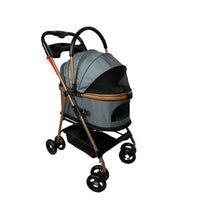
Where a dog stroller genuinely belongs is the rest of the trip: outdoor markets, garden centres, pet shops, hardware stores and the walk in between.
Those are the places with nothing on the shelves that a health inspector cares about.
Our guide to which shops allow dog strollers covers where that holds.
For an Older Dog That Comes Along Anyway
Plenty of these trips are not really about the shop. They are about a dog that used to come everywhere and is now managing less of it.
A patio table, an outdoor market and a slow lap of a shopping street are the parts still available once a supermarket floor is not, and a dog that tires quickly can still do all of them sitting down.
The Whisker Bark luxury pet stroller folds flat for a boot and zips over in weather, which is what keeps a slower dog in the day out rather than left at home.
When a Service Dog Can Be Asked to Leave
Two situations, and they apply to genuine service animals as much as to anyone else.
A dog that is out of control while the handler takes no effective action to control it, and a dog that is not housebroken.
In either case the business can ask for the animal to be removed and must still offer to serve the person without the dog present.
Share