

Dog Car Anxiety: How to Actually Fix It
Car anxiety in dogs is a learned fear, not a temperament problem. It usually comes from what the car predicts rather than the car itself, which is why it gets worse over time instead of better. Fixing it means changing the prediction, and that is done through slow, repeated exposure rather than through a calming product.
The important thing to understand early is that this is the opposite of motion sickness. A dog who gets car sick generally improves as they mature. A dog who is afraid of the car gets worse with every trip, because each bad journey is another repetition confirming that the fear was justified.
Fear or Nausea?
They look almost identical, and the treatments have nothing in common.
Anxiety shows up before the car moves. The dog hesitates in the driveway, backs away from the door, whines with the engine off, or has to be lifted in. Motion sickness starts once the vehicle is moving and settles soon after it stops.
The other test is direction of travel over months. Improving on its own points to motion sickness. Getting steadily worse points to fear. If your dog is somewhere in the middle, or you are not sure, our guide to car sickness in dogs has a fuller comparison, and it is worth ruling out nausea before you commit to a behaviour plan.
Where the Fear Comes From
For most dogs it is arithmetic. If the majority of car journeys end at the vet, the groomer, or the boarding kennel, the car is a reliable predictor of something unpleasant. Dogs are good at spotting that pattern and they do not weigh it against the trips to the park.
Rescue dogs often arrive with a version of this already installed. A dog who was transported between shelters, moved between homes, or taken away from somewhere familiar has a history in vehicles that you were not present for and cannot undo. What you can do is outnumber it.
Then there is the ride itself, which is genuinely disorienting if you are not driving. The dog cannot see what is coming, cannot brace in advance for a turn, and is being moved through space with no control over any of it. Add a surface that slides under their feet and the experience is closer to standing on a boat than sitting in a room.
What Anxiety Looks Like
The obvious signs are trembling, whining or barking, panting, drooling, pacing, and trying to hide or escape. Vomiting and diarrhoea happen too, which is part of why fear and nausea get confused.
The quieter signs are the ones that matter for training, because they tell you the dog is near their limit before anything dramatic happens. Ears back against the head, a closed mouth with wide eyes, backing away, going very still. And displacement behaviours, which look like ordinary dog activity in the wrong context: sniffing the ground intently, sudden self grooming, licking, sneezing, scratching.
There is one reliable field test. A dog who will not take a favourite treat is over threshold. Food refusal in a dog who is normally food motivated means you have gone too far, too fast, and the answer is to make the situation smaller rather than to push through it.
The Work That Actually Fixes It
Desensitisation means exposing the dog to the car at an intensity low enough that they stay calm. Counter conditioning means pairing it with something good so the prediction changes. Together they are the only approach with real evidence behind them, and the evidence is decent: in a survey of over 900 owners, dogs habituated to car travel as puppies had travel problems at 6.3 percent against 24.1 percent for those who were not.
The single rule that separates this working from not working: reward the dog for choosing to approach, never lure them in with food. A dog lured over threshold has not decided the car is safe. They have decided the food was worth it, and the fear is untouched underneath.
- Work outside the parked car. Engine off, doors closed. Reward looking at it, then any movement toward it. This might be a few minutes or genuinely a few seconds. Every day or every other day, for a few weeks.
- Open a door. Keep rewarding approach. Do not ask for anything.
- Reward feet going in, and let them come straight back out. Free exit is what makes entry tolerable.
- Sit in the stationary car together. High value food only. Feeding meals in there is a good use of this stage.
- Engine on, then off again immediately. Reward right after the noise. Build duration over sessions.
- To the end of the drive and back. Then round the block.
- Short trips to good places. A park, a friend's house, the pet shop. Vary the route to the same destination so the dog is not reading turns.
If the dog goes over threshold, drop back a step or shrink the current one. Nobody has ever ruined this by going too slowly. Counter conditioning takes longer than desensitisation and the whole thing is measured in weeks.
Two safety notes, and they are not negotiable. Do not run these sessions on a hot or very cold day, and never leave your dog alone in the car to do them, not even for a minute while you fetch something. The reason that matters more than most people think is in our guide to leaving a dog in a parked car.
Setting Up the Car So It Helps
The environment will not cure fear, but it can stop working against you. A dog spending the drive physically managing an unstable surface has nothing left for learning that the car is fine.
Stable footing. When paws slide, the dog cannot predict what their own body is about to do, and that is its own source of stress independent of anything else. A flat, anchored surface lets a dog lie down instead of standing and constantly correcting. Why a rigid base does this and a padded one does not is covered in our guide to hard bottom seat covers.
A forward line of sight. Many anxious dogs settle better when they can see where they are going, because turns and stops stop being ambushes. A mesh panel gives that without the full sensory load of an open window.
A consistent spot. Same place, every trip. Predictability is the entire currency here.
Restraint, fitted before the training starts. A frightened dog who can move around the cabin will, and a dog who has learned they can climb into the front has learned something you will have to undo later. Our guide to securing a dog in a car covers what actually works, and what the phrase crash tested is worth on a harness label.
Nothing new in the cabin. Strong air fresheners and heavy cleaners add stimulation to a dog already managing too much. Neutral is better than pleasant.
A blanket that lives in the car. Something that smells of home, kept only for the car, so it becomes a signal rather than just bedding. It is one of the few genuinely useful items on the usual travel packing list.
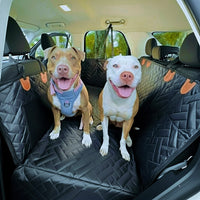
Our hard bottom seat cover is built around a rigid base for the footing problem specifically, with a mesh panel for the line of sight. It is a foundation for the training rather than a substitute for it.
Where Should an Anxious Dog Sit?
| Position | Suits | Watch for |
|---|---|---|
| Back seat, one side | Most anxious dogs, who want a defined space | Avoid the door that opens most if your dog startles |
| Back seat, centre | Dogs who settle better tucked in with a forward view | Some dogs dislike windows on both sides |
| Cargo area | Dogs who overstimulate easily and prefer a quieter space | Often nothing back there is rated to clip a restraint to |
Calming Products, Assessed Honestly
We would rather tell you what the evidence says than sell you something that does not work.
Pheromone sprays and collars. A formal veterinary evidence review concluded that the case for using dog appeasing pheromone in dogs over six months old remains weak, with no formulation outperforming another and little effect persisting after exposure. Harmless, cheap, worth a try alongside the real work. Not a treatment.
Calming chews. Blends of tryptophan and milk protein derivatives have shown at best a mild effect in trials, none of them car specific.
CBD. Two small placebo controlled trials exist, both funded by the companies involved. They found reductions in stress markers, and in the longer trial the effect had faded by six months. The category is unregulated and interacts with other medications.
Thundershirts and pressure wraps. Popular, and the evidence is thin. Low risk, so trying one costs little beyond the price.
Music. Consistent low tempo sound masking road noise is reasonable, and the value is probably the consistency rather than the music.
None of these should be the plan. They are things you might add to a plan.
Medication
For a genuinely fearful dog, medication is not a failure and it is not a shortcut. A dog who is over threshold on every trip cannot learn anything, so the drugs are often what makes the training possible.
What a vet is likely to discuss: trazodone and gabapentin, sometimes a benzodiazepine, often started the evening before travel. All prescription, all used off label in dogs, all requiring a conversation about your specific dog. We are not going to print doses.
Three corrections worth having, because all three circulate widely and one of them appeared on this page in an earlier version.
Cerenia is not an anti anxiety drug. Maropitant prevents vomiting. If your dog's problem is fear, it will keep them from being sick without touching the fear.
Benadryl sedates rather than calms. A drowsy dog is not a dog whose fear has been addressed, and some dogs become agitated on it.
Acepromazine is no longer the default, and there is a reason. Veterinary behaviourists have moved away from it because it can make a dog easier to handle without reducing the fear at all. The result is a dog who cannot move and is still frightened, which is worse than it sounds, because they are still building the negative association while unable to do anything about it. If it is offered, it is entirely reasonable to ask whether something that reduces the fear itself would be a better fit.
What Makes It Worse
- Pushing through it. One trip that overwhelms the dog can undo weeks of progress.
- Only driving to the vet. If nothing changes about the destinations, nothing changes about the prediction.
- Comforting at the wrong moment. Soothing a panicking dog is human and it is not harmful, but it does not help either. Changing the situation does.
- Long trips too early. The temptation once things improve is to test it on a real journey. Extend gradually instead.
- Loading in a hurry. A rushed, scrambling entry is a bad first thirty seconds and it colours the rest.
The Short Version
Rule out nausea first, since the two look the same and need opposite responses. Then work outside the car before you work inside it, reward the dog for choosing to approach rather than luring them, and treat a refused treat as a signal to make things easier. Give them stable footing and a forward view so the ride itself stops adding to the problem. Talk to your vet about medication if your dog is too frightened to learn. And take the weeks, because there is no version of this that works quickly.
Share